

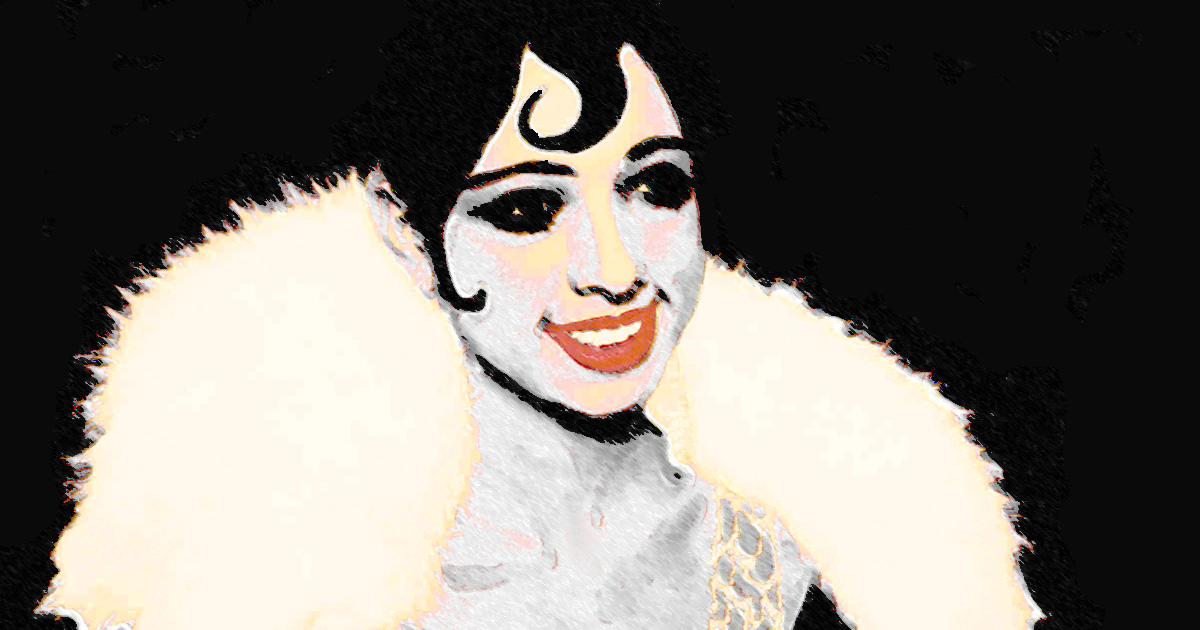
Global star | Resistance heroine | Civil rights activist
June 3 | The birthday of
Josephine Baker (1906 – 1975)
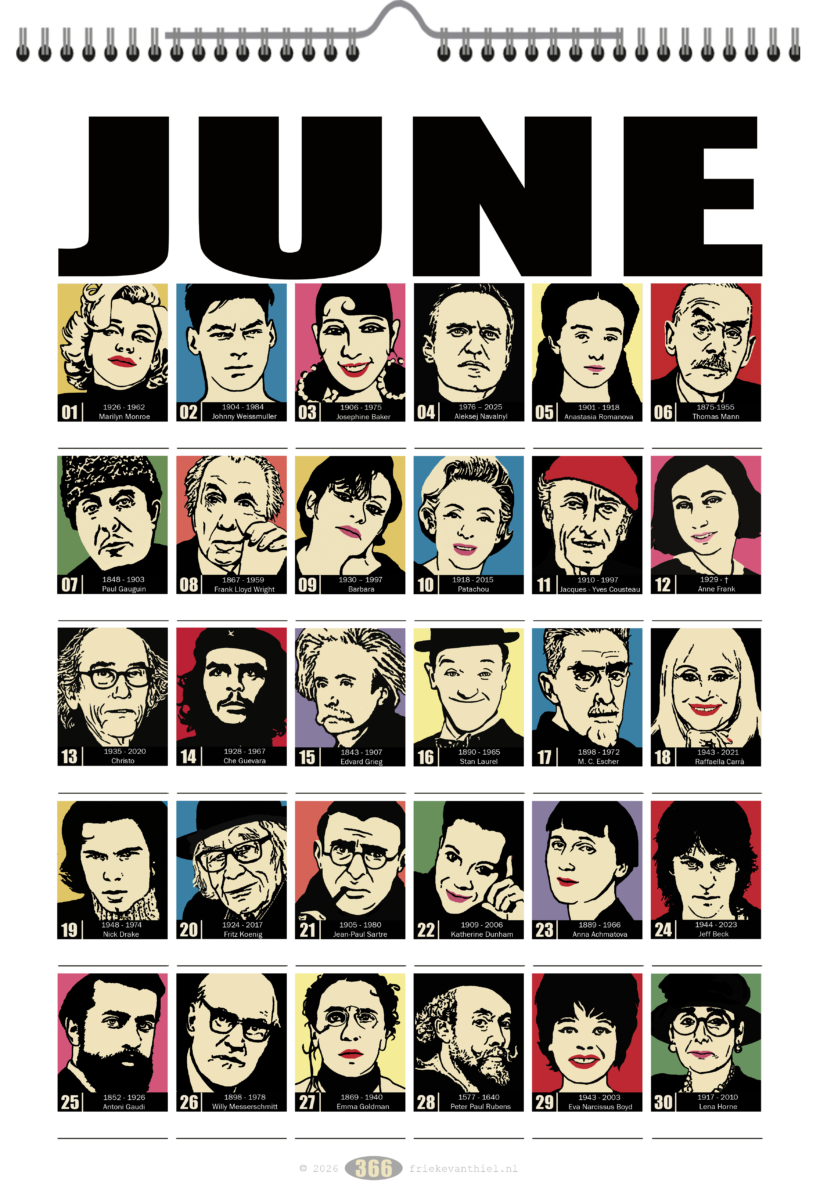
One of the most extraordinary women of the twentieth century. Born into poverty in St. Louis, Missouri, she rose to become Paris's most celebrated entertainer, a courageous spy for the French resistance movement during World War II, and a tireless fighter for civil rights. Her full story can be found further down in this blog. The digital edit and the birthday calendar featuring 366 legendary figures were made by me, Frieke van Thiel.
Youth in Poverty: St. Louis, Missouri (1906–1921)
Josephine Baker was born Freda Josephine McDonald on June 3, 1906, in St. Louis, a city that was heavily burdened by racial segregation at the time. Her mother, Carrie McDonald, worked as a laundress, and her biological father left the family early on. From a young age, Josephine helped strangers as a domestic servant. She sometimes slept on the street or in ash chests to stay warm during the winter.
At the age of ten, she began dancing on street corners for money. This early performance for passersby laid the foundation for a career that would change the world. At fifteen, she married for the second time—her first teenage marriage had ended quickly—and joined touring vaudeville troupes in the United States.
Broadway and the Leap to Europe (1921–1925)
In the early 1920s, Josephine Baker reached Broadway via the revues 'Shuffle Along' and 'The Chocolate Dandies'. Although she was initially cast as a comedic supporting character, she soon stood out for her exuberant presence, her funny facial expressions, and her magnetic dance style.
In 1925, she received an irresistible offer: to perform in Paris for 'La Revue Nègre' at the Théâtre des Champs-Élysées. She seized the opportunity with both hands. In segregated America, she was a second-class citizen; in Paris, she would become a goddess.
Folies Bergère and the Banana Dance (1925–1939)
Paris received Josephine Baker as a revelation. Her performance in the 'Revue Nègre' caused a sensation. Artists and intellectuals such as Pablo Picasso, Ernest Hemingway, and F. Scott Fitzgerald were deeply impressed. She was called the 'Black Venus', the 'Bronze Venus', and the 'Creole Goddess'.
Her performance in the revue 'Un vent de folie' (1927) at the Folies Bergère became legendary. Dressed in nothing but a skirt of artificial bananas and a beaded necklace, she danced a Charleston that stunned the audience—and the entire art world. The banana dance became an icon of the Jazz Age and the Roaring Twenties, making her the highest-paid female entertainer in the world.
In that same year, she played the lead role in 'La Sirène des Tropiques'. With this, Josephine Baker became the very first Black woman to play the lead role in a major commercial feature film.
🎬 Watch the famous performances:
▶ Josephine Baker – Banana Dance at Folies Bergère (1927)
▶ Josephine Baker dances the Charleston (1925)
▶ Josephine Baker – Dancing Up A Storm (1926–27)
▶ Josephine Baker dances the Charleston in the Netherlands (August 28, 1928)
Heroine of the French Resistance
When Nazi Germany occupied France in 1940, Josephine Baker refused to flee or remain silent. She joined the French resistance movement (omit the capital letter for resistance movement unless you mean a specific organization) and worked as an undercover agent for the intelligence service of the Free French. She transported secret information—sometimes literally written in her underwear with invisible ink—through the neutral countries of Spain and Portugal.
Thanks to her celebrity status, she was able to cross borders where ordinary people were stopped. She also solicited contacts and funds for General Charles de Gaulle's Free France. For her fearless dedication, she received the highest French military decorations after the war: the Médaille de la Résistance and the Légion d'honneur with the rank of Officer.
📽️ More about Baker's wartime career:
▶ Josephine Baker: The Wartime Life of the African American Star (2025)
Civil rights fighter and the Rainbow Tribe
After the war, Josephine Baker resumed her struggle—now in the field of civil rights. She adamantly refused to perform for a segregated audience in the United States and demanded equal access for Black and white visitors. For the first time in their history, various clubs and hotels made an exception due to her international star status.
In 1963, she was the only woman to officially speak on the stage alongside Martin Luther King during the historic March on Washington (known for the 'I Have a Dream' speech). She stood in her French military uniform before a crowd of more than 250,000 people.
Her most personal project was the so-called 'Rainbow Tribe': she adopted twelve children from different countries and cultures – including Japan, Colombia, Finland, Morocco, and Algeria – and raised them in her château Les Milandes in the Dordogne. For her, this was living proof that people of all races and faiths could live together in harmony.
Comeback and death (1973–1975)
After years of severe financial difficulties – during which she eventually even lost her beloved Les Milandes – Josephine Baker made a triumphant comeback at Carnegie Hall in New York in 1973. The audience received her with an emotional standing ovation.
In April 1975, on the occasion of her fiftieth anniversary as an artist, she opened a brand-new revue in Paris. The show was completely sold out; the hall was filled with friends, fans, and icons from the fashion world. Just a few days later, on April 12, 1975, she died in her sleep at the age of 68 from the effects of a cerebral hemorrhage.
She received a state funeral in Monaco and was the first American woman ever to be buried with military honors in France. Moreover, in November 2021, she became the sixth woman ever inducted into the French Panthéon – the ultimate recognition by the French state for her exceptional contribution to freedom, humanity, and equality.
▶ Joséphine Baker: Avec! – (1969)
Josephine Baker's legacy
Josephine Baker was much more than a dancer or entertainer. She was an absolute pioneer – the first Black international superstar – a resistance heroine, a mother, and an activist. Her life illustrates how art and courage can change the world: from a street child in segregated America to a legend who rests in the Pantheon.
Her influence is still felt in fashion, dance, music, film, and the civil rights movement. Contemporary artists such as Beyoncé and Janet Jackson consistently cite her as a major source of inspiration. Her story is more relevant than ever: a testament to strength, identity, and the tireless struggle for a just world.
🎬 Watch these documentaries:
▶ The Scandalous and Triumphant Life of Josephine Baker (2024)
Gift idea
You can order the digital edit of this legendary woman from me as a print: poster, canvas, or dibond. Choose a size and optionally a color that suits your interior — an original gift, also for yourself... From €35. Send me a message via [contact] and we'll create something beautiful together. On request, I'll make a mockup so you can see how it will look on your wall.