

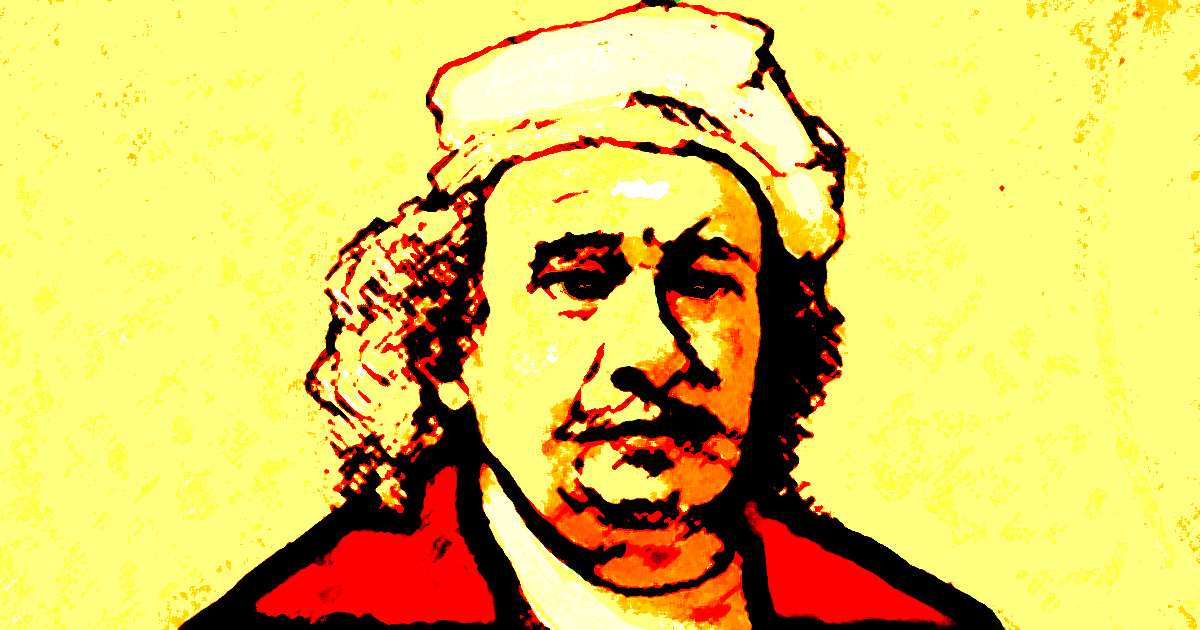
Dutch Master from the Golden Age.
July 15 | The birthday of Rembrandt van Rijn (1606-1669), one of the most famous painters the Netherlands has ever produced. He rose to become the most important painter of the Dutch Golden Age. His work is characterized by a penetrating use of light and dark, honest self-portraits, and a life full of success, loss, and adversity. In this article, you can read more about his youth, his breakthrough in Amsterdam, and the legacy he left behind. The digital edit and the 366 birthday calendars featuring his portrait were created by me, Frieke van Thiel.

Youth and education in Leiden
Rembrandt Harmenszoon van Rijn was born on July 15, 1606, in Leiden, as one of ten children of the Leiden miller Harmen Gerritszoon van Rijn and Neeltgen Willemsdochter van Zuytbrouck, a baker's daughter. There is some uncertainty regarding the precise year of birth: a biography from 1641 mentions 1606, while other documents point to 1607. In the Netherlands, July 15, 1606, is generally accepted as his date of birth.
As the son of a miller, Rembrandt initially attended Latin school and briefly enrolled at Leiden University in 1620. An academic career proved not to be his calling: he soon chose painting as his profession. He became a pupil of the Leiden history painter Jacob van Swanenburgh and subsequently left for a short but influential apprenticeship with Pieter Lastman in Amsterdam, who introduced him to biblical and historical themes.
A studio of my own and the breakthrough
Back in Leiden, Rembrandt opened his own studio around 1625, which he shared with his childhood friend and rival Jan Lievens. The two painters were noticed by Constantijn Huygens, secretary at the court of the Prince of Orange, who introduced Rembrandt to important patrons. This early Leiden period (1625–1631) laid the foundation for his later fame.
In 1631 or 1632, Rembrandt moved to Amsterdam, at the time the most prosperous city of the Republic. He moved in with art dealer Hendrick van Uylenburgh and quickly built a reputation as a portrait painter. Works such as The Anatomy Lesson of Dr. Nicolaes Tulp (1632) demonstrated his talent for composition and his characteristic chiaroscuro, the sharp interplay of light and shadow.
Saskia van Uylenburgh and personal happiness
In 1634, Rembrandt married Saskia van Uylenburgh, a cousin of his business partner Hendrick. The marriage brought Rembrandt prestige and prosperity, and in 1639 the couple were able to purchase a stately house on Sint Antoniesbreestraat in Amsterdam, now known as the Rembrandt House. Of the four children Saskia and Rembrandt had, only son Titus, born in 1641, survived childhood.
Shortly after Titus's birth, Saskia died, probably of tuberculosis. Rembrandt was left behind with his son, while simultaneously working on what would become his most famous painting.
The Night Watch: the highlight of his painting
Between 1640 and 1642, Rembrandt painted The Night Watch, a group portrait of a militia guild that is considered one of the most important paintings in Dutch art history. Instead of a static group portrait, Rembrandt opted for a dynamic, almost theatrical composition full of movement and light, thereby deviating from the prevailing conventions of his time. The canvas currently hangs in the Rijksmuseum in Amsterdam.
Financial setbacks and bankruptcy
Despite his artistic success, Rembrandt failed to keep his finances in order. He lived beyond his means, made expensive purchases for his art and curiosities collection, and after Saskia's death, rarely received commissions for portraits. In 1656, he personally applied for 'cessio bonorum': an honorable form of bankruptcy that prevented imprisonment. His art collection and household effects were auctioned off in the following years, and in February 1658, his house on Sint Antoniesbreestraat was also sold under duress. To avoid further problems with creditors, Hendrickje Stoffels and her son Titus started an art dealership after moving to the Rozengracht, which was formally established as a partnership in December 1660, with Rembrandt on the payroll as their employee.
Hendrickje Stoffels and the last years of life
Around 1645, Hendrickje Stoffels entered Rembrandt's service as a housekeeper; she later became his life partner. Together they had a daughter, Cornelia, born in 1654. Despite financial difficulties, Rembrandt continued to paint into old age, with a series of poignant self-portraits from his final years as a well-known result.
Life continued to bring Rembrandt setbacks: Hendrickje died in 1663, and his son Titus died in September 1668, shortly after his marriage to Magdalena van Loo. Rembrandt himself died on October 4, 1669, in Amsterdam, at the age of 63. Four days later, he was buried in a rented grave in the Westerkerk.
Style and artistic legacy
Rembrandt's oeuvre comprises an estimated three hundred paintings, three hundred etchings, and two thousand drawings. His work is classified as Baroque and is clearly influenced by Italian Caravaggism, although Rembrandt himself never visited Italy; he adopted the influence through his teacher Pieter Lastman. Art historians generally divide his career into five periods, beginning with the Leiden period from 1625 to 1631.
His mastery of light and dark, his psychologically sharp portraits, and his dozens of self-portraits make him one of the most studied artists in the world. Museums such as the Rijksmuseum and the Rembrandt House in Amsterdam still attract millions of visitors every year who want to see his work.
Rembrandt van Rijn and the 366 calendar
With his birth date of July 15, the life story of Rembrandt van Rijn aligns perfectly with the concept behind the 366 calendar: every day of the year is linked to a remarkable person.
Sources
Rembrandt van Rijn – Wikipedia
Would you like to be portrayed yourself or someone dear to you in the same style as Rembrandt's portrait? I specialize in creating portraits of people and animals, dynamic or posthumous. Choose a size and optionally colors that match your interior.
Send me a message via [contact] and we will create something beautiful together. Upon request, I can make a mockup so you can see how it looks on your wall. My hourly rate is €23.00 incl. VAT.