

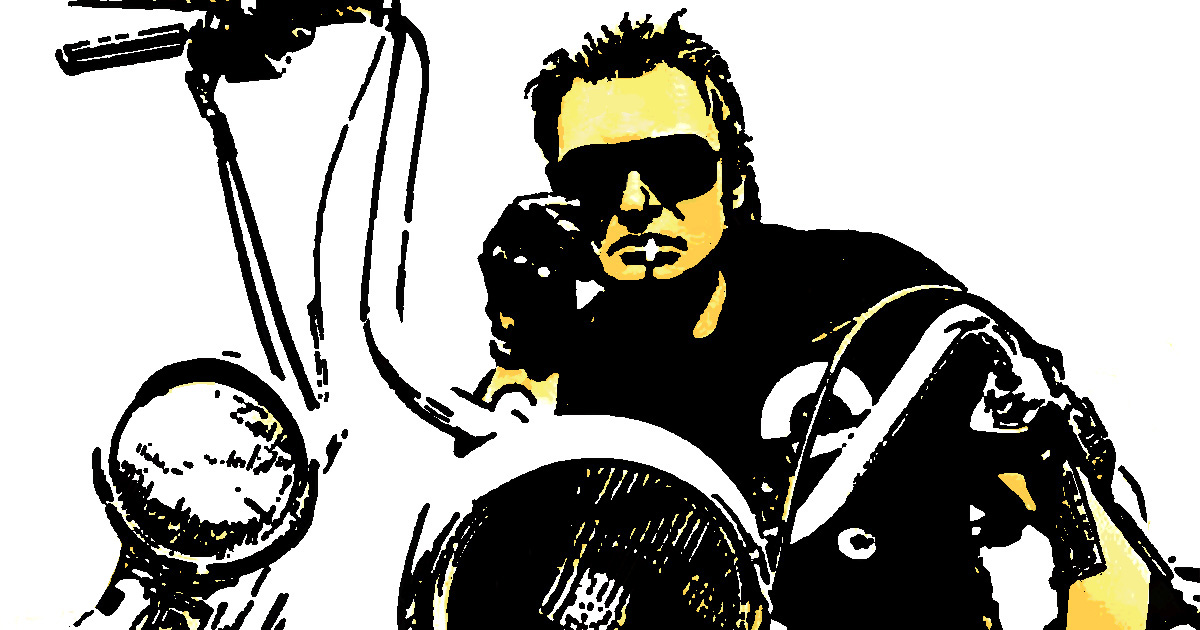
The rock 'n' roll king of France
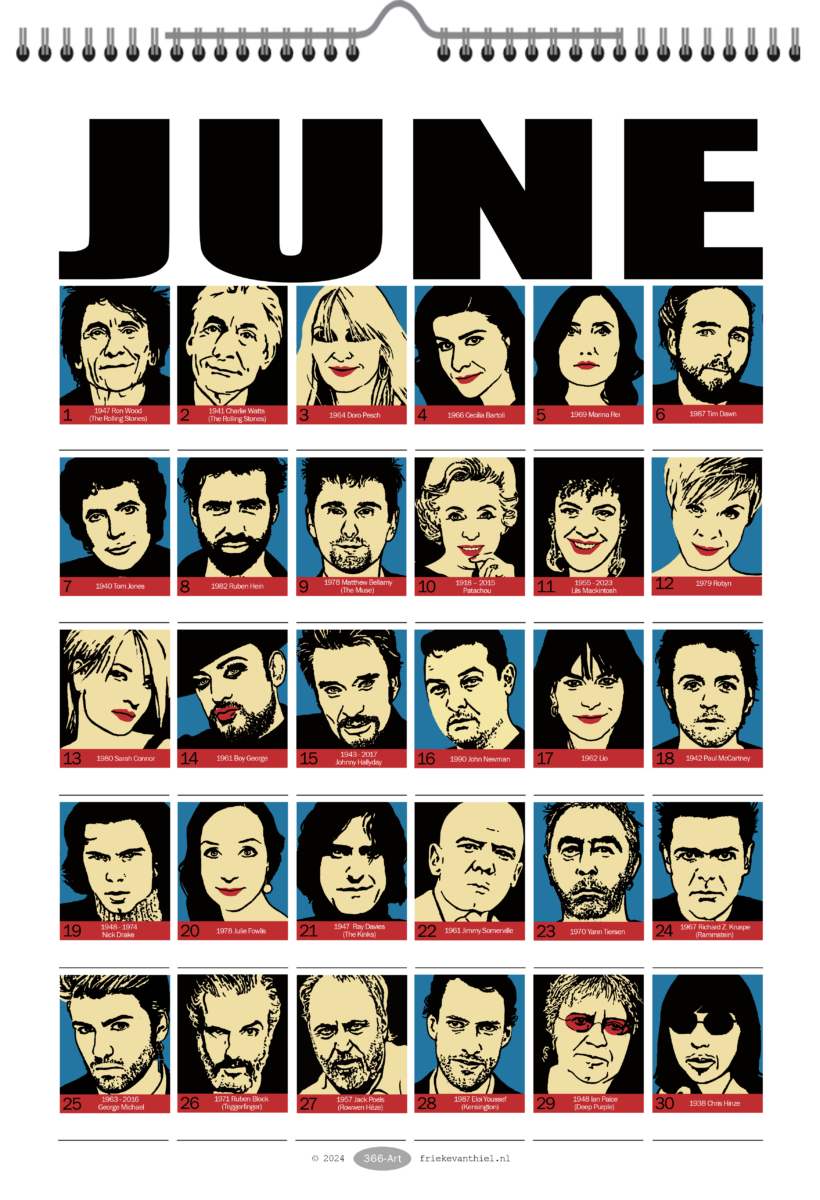
June 15 | The birthday of Johnny Hallyday (1943 – 2017), the greatest rock star the French music world has ever produced. His biography follows further down in this blog. The digital edit of Hallyday on his motorcycle and the birthday calendar featuring 366 European musicians are made by me, Frieke van Thiel.
Johnny Hallyday brought rock 'n' roll to a country that until then had been dominated mainly by French-language songs, and grew into a true legend: loved by generations, revered by millions, and immortalized by his raw, emotional voice and his spectacular live shows. With more than 110 million records sold, 51 studio albums, and over 3,200 concerts in a 57-year career, Hallyday ranks among the global top-selling artists of all time. Despite his international status, he always remained most deeply rooted in the French-speaking world, where he is simply called 'Johnny' — a name that needs no surname.
Early years: from Smet to Hallyday (1943–1960)
Johnny Hallyday — born Jean-Philippe Léo Smet on June 15, 1943, in Paris — was born into a difficult home situation. His father, a Belgian artist, left the family shortly after his birth. He was raised by his aunt Hélène and her husband, the dancer Lee Hallyday, whose surname he would later adopt as his stage name.
As a teenager, he became obsessed with American rock 'n' roll — Elvis Presley, Eddie Cochran, and Gene Vincent were his great heroes. He taught himself to play guitar and performed in small Parisian clubs from an early age. In 1960, at seventeen, he made his television debut and immediately captured the hearts of French youth with his wild energy and rebellious image.
The Breakthrough: Rock 'n' Roll in France (1960–1969)
In the early 1960s, Johnny Hallyday was a phenomenon. While older generations viewed him with suspicion, young French people adored his raw guitar sound and his sensual stage performances. He caused literal riots: at his concert in the Palais des Sports in Paris in 1961, panic broke out among the tens of thousands of fans.
His hits piled up: 'Souvenirs Souvenirs' (1960), 'Retiens la nuit' (1962), and 'La Génération perdue' brought him to the top of the French charts. He was not only a musician but also a cultural symbol — the personification of youth, freedom, and rebellion.
In 1969, he broke through to a new artistic level with the beautiful 'Que je t'aime', which topped the charts in France for eleven weeks. To this day, the song remains one of his best-known and most cherished tracks.
🎬 Que je t'aime — Rester Vivant Tour — One of his most iconic songs, live and full of passion
Artistic highlights and legendary concerts (1970–2000)
The seventies and eighties were a period of artistic growth and personal challenges. Johnny experimented with hard rock, blues, and even gospel, and collaborated with top producers from around the world. Yet he always remained recognizably himself: that powerful, smoky voice, that emotional intensity.
His concerts grew into spectacular events. In 1993, he filled the Parc des Princes in Paris for several nights in a row — an achievement that instantly cemented his position as the greatest live artist of the French-speaking world. He arrived on stage through the crowd, creating unprecedented scenes.
In 1998, he performed for nine consecutive nights at the Stade de France for a total of more than 600,000 visitors. During his famous performance on September 11, 1998, he sang 'Allumer le feu' — literally 'Light the fire' — and the audience truly lit the fire: a visual spectacle that has gone down in live music history.
🎬 Legendary live performance — Stade de France 1998
Musical style and influences
Johnny Hallyday was first and foremost an interpreter. He rarely wrote his own songs, but his gift for bringing a song to life was unparalleled. He took American rock 'n' roll classics and French chansons and turned them into something entirely his own — rawer, more emotional, more theatrical.
His musical style evolved constantly: from pure rock 'n' roll in the sixties, through hard rock and psychedelia in the seventies, to ballads and country influences in the eighties and nineties. His characteristic voice always remained central: powerful, muscular, and at the same time surprisingly vulnerable.
Major sources of inspiration were Jimi Hendrix, Bruce Springsteen, and his absolute idol Elvis Presley (whom he met briefly in Paris in 1960). He saw himself as the bridge between American rock 'n' roll and the French audience — and he fulfilled that role like no other.
Most famous songs and must-see live videos
Below you will find a selection of Johnny Hallyday's greatest hits, each paired with an official or historic live performance on YouTube. This is the perfect introduction for those who don't know him yet, and a feast of recognition for the true fan.
🎬 1. The Penitentiary (1964) — his first major international hit, based on 'The House of the Rising Sun'‘
🎬 2. Que je t'aime (1969) — 11 weeks number 1 in France:
🎬 3. Allumer le feu Live Stade de France (1998) — one of the most impressive live performances ever
🎬 4. Requiem for a Madman — Live in Lyon 2015 — masterful performance
🎬 5. Full live concert — Live Bercy 2006 (complete DVD) — More than 2 hours live
The final years and the farewell (2000–2017)
In the 2000s, Johnny Hallyday remained undiminished in his activity. He toured, recorded new albums, and filled stadiums—even at an advanced age. His fans were fanatically loyal: tickets for his concerts sold out within minutes.
The year 2009 marked the beginning of severe health problems, including treatment for bowel cancer and complications following hernia surgery. However, he did not receive the definitive and fatal diagnosis of lung cancer until 2016. Nevertheless, he remained on stage until the very end. His final major tour, the 'Rester Vivant Tour' (2015–2016), was a huge artistic and commercial success.
On December 5, 2017, Johnny Hallyday died at the age of 74 from lung cancer at his home in Marnes-la-Coquette. The funeral procession through Paris was attended by hundreds of thousands of people. President Emmanuel Macron spoke at his farewell and called him 'a part of ourselves'.
His final studio album, 'Mon Pays c'est l'Amour', was released posthumously in October 2018 and broke all sales records in France. It debuted at number 1 and remained on the charts for months.
Legacy and influence on French music
Johnny Hallyday changed French music culture forever. He proved that rock 'n' roll didn't have to be exclusively Anglo-Saxon, that you could cry, dance, and rage to it in French too. He opened the door for generations of French rock musicians who came after him.
His influence extends from hard rock to chanson, from cinema (he acted in more than twenty films) to fashion. He was married five times, was the father of four children, and lived his life as dramatically as his music — in the full public spotlight.
His records are still being sold, his concerts re-released, and his songs covered. On YouTube, his official channel has tens of millions of views. Johnny Hallyday isn't gone — he's just somewhere on a big stage, with a guitar and a microphone, for the audience of his life.
Johnny Hallyday in all his glory:
Gift idea
You can order the digital edit of the iconic Johnny Hallyday from me as a print: poster, canvas, or dibond. Choose a size and optionally a color that fits your interior — an original gift for a fan, or for yourself (that is allowed too). From €35. Send me a message via [contact] and we'll create something beautiful together. On request, I'll make a mockup so you can see how it will look on your wall.