

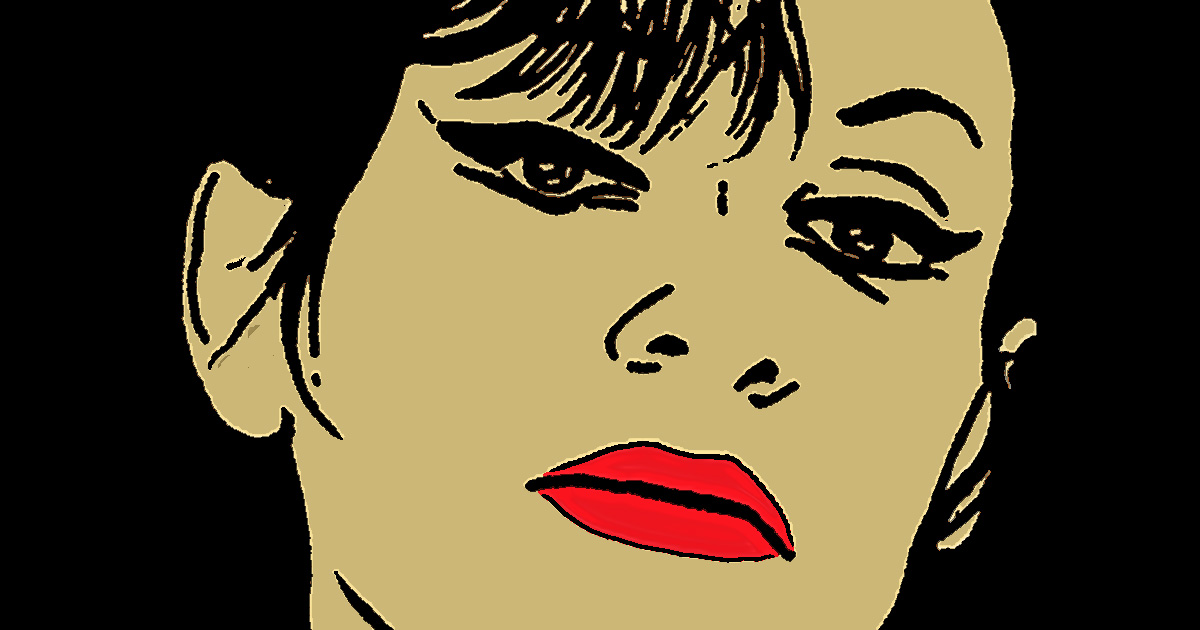
The elegant 'Dame en Noir' of French chanson.
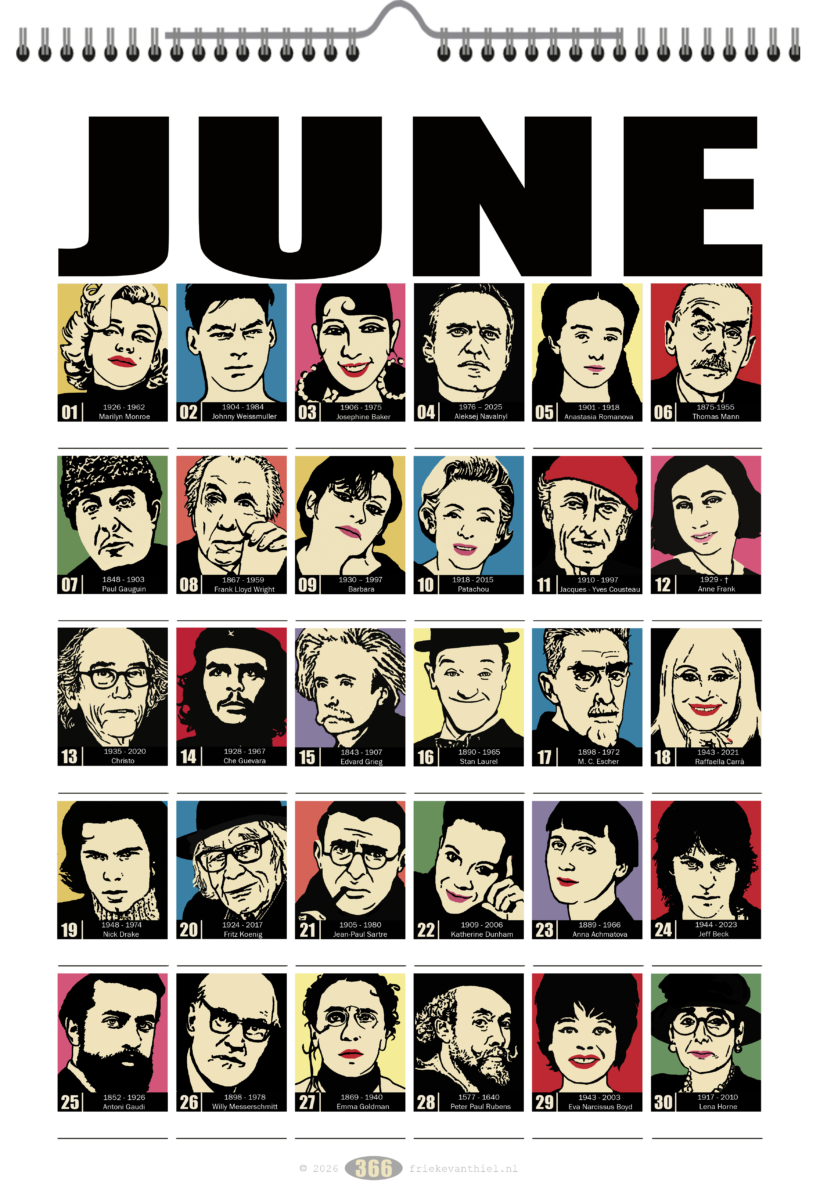
June 9 | The birthday of Barbara (1930–1997) — the absolute pinnacle of the French chanson tradition. Her dark and intense stage presence made her a legend. Her biography follows further down. The digital rendering of her portrait and the birthday calendar featuring 366 legendary figures were made by me, Frieke van Thiel.
Youth and war years (1930–1950)
Monique Andrée Serf was born on June 9, 1930, in Paris, on Rue Brochant in the 17th arrondissement. Her father, Jacques Serf, was an Alsatian leather merchant of Jewish descent; her mother, Ester Brodsky, was from Tiraspol (present-day Moldova). Barbara was the second of four children: she had an older brother, Jean, and two younger sisters, Régine and Claude.
Barbara's childhood was overshadowed by the Second World War. As a Jewish family, they fled the Nazi occupation and moved from city to city—Roanne, Tarbes—constantly on the run. Barbara's father sexually abused her, a trauma she kept hidden for decades but which cast a shadow over her entire oeuvre. It was not until her posthumously published autobiography, 'Il était un piano noir' (1998), that she spoke openly about it.
“Il était un piano noir… Des fois il faisait semblant d'être mort.” — from the autobiography Il était un piano noir (1998)
Despite the turbulence of the war years, Barbara discovered her passion for music and singing. A local schoolteacher recognized her talent and encouraged her education. After the liberation, she settled permanently in Paris and began studying piano at the Conservatoire National Supérieur de Musique. Music became her lifesaver.
First steps on the stage (1950–1958)
In the early 1950s, Barbara began performing in the small Parisian cabarets and chansonniers. She performed under her own name and accompanied herself on the piano. The small, intimate stage suited her perfectly. In Paris, she performed regularly at the Aux Trois Baudets — the legendary cabaret that also launched Brel and Brassens — and acquired a loyal fan base.
Her repertoire initially consisted of works by others: chansons by Brel, Brassens, and Piaf. But she soon began writing her own songs. Her style—intimate, vulnerable, sometimes almost whispered and then suddenly erupting in a storm of emotion—immediately distinguished her from her contemporaries. In 1958, she released her first single and acquired the nickname 'La Chanteuse de Minuit' (the Midnight Singer).
Breakthrough and first major successes (1958–1968)
Barbara made her debut around 1959–1960 at the famous Bobino Theatre in Paris. The major breakthrough followed in 1964, when she played to a sold-out Bobino for weeks. The audience was won over by her unique combination of piano, poetic lyrics, and theatrical presentation. The album 'Barbara chante Barbara' (1964) marked her artistic maturity: for the first time, an entire album consisted of her own compositions.
In 1964, she wrote 'Dis, quand reviendras-tu?' — a poignant song about longing and farewell that immediately became a classic. To this day, the song is considered one of the most beautiful chansons ever written.
▶ Dis, quand reviendras-tu? — Carrefour, RTS Geneva, June 5, 1965 — Recording for Swiss Television (RTS), Geneva, June 5, 1965
In 1964, Barbara traveled to Göttingen (West Germany) for a tour. What she experienced there—the warm welcome by a generation that knew the war—inspired her to write the song of the same name. 'Göttingen' was released as a single in 1965 and became an ode to Franco-German reconciliation; it grew into one of her most beloved songs, even outside France.
▶ Göttingen—live television recording (ca. 1964/1965) — The song that celebrated Franco-German friendship, live in Paris
In 1966, she released 'Ma plus belle histoire d'amour,' dedicated to her audience. The song—in which she sings of her relationship with her listeners as the most beautiful love story—became her trademark. Barbara: 'Vous êtes ma plus belle histoire d'amour.'‘
▶ Ma plus belle histoire d'amour — Live Pantin 1981 — Barbara in concert in Carpentras/Pantin: goosebumps from the first note
The highlight: L'Aigle noir en Pantin (1970–1981)
In 1970, Barbara released her masterpiece: 'L'Aigle noir' (The Black Eagle). This song—mysterious, mythical, and deeply autobiographical—is about a black eagle that visits her in her dream. Many read it as a metaphor for her traumatic childhood and the abuse by her father. The song sold more than a million copies in just twelve hours—an unprecedented record for French chanson.
“Un beau jour, ou peut-être une nuit, près d'un lac je m'étais endormie…” — opening lines of L'Aigle noir (1970)
▶ L'Aigle noir — Live Pantin 1981 — HQ stereo live recording: the tension is palpable
▶ L'Aigle noir — Live Châtelet 1993 — Official Universal Music recording, Théâtre du Châtelet Paris
The 1970s were a period of artistic maturity for Barbara. She composed, wrote, and produced her albums entirely by herself — exceptional for a woman at that time. She collaborated with big names such as Gérard Depardieu (for the play 'Lily Passion' in 1985). Her concert at the Hippodrome de Pantin (1981) is considered one of the most famous and emotional live shows in French music history.
▶ Concert in Carpentras 1973 (complete) — Rare complete concert recording: Barbara at her very best
Late career and retirement (1981–1997)
After Pantin, Barbara continued to perform, compose, and amaze. In 1985, she collaborated with actor Gérard Depardieu on 'Lily Passion', a theatrical musical spectacle that played to sold-out houses for months. In 1987, she performed at the Théâtre du Châtelet, and again in 1993—her very last major concert series. The album 'Châtelet 93' became a monumental live recording.
Her final years were marked by poor health. She suffered from lung and heart problems. Yet she continued to write and make music, albeit in silence. On November 24, 1997, Barbara died in Neuilly-sur-Seine at the age of 67. All of France mourned; President Jacques Chirac commemorated her as 'a unique voice of France.'‘
▶ L'Aigle noir — Live Châtelet 1993 (Orchestral) — With full orchestra: a grandiose conclusion to her live career
Musical style and themes
Barbara's music is instantly recognizable: a warm, deep alto voice that floats above the simple yet brilliant piano playing. Her compositions are interwoven with poetry, symbolism, and autobiography. Recurring themes in her work are:
- Loss and longing: the absence of loved ones, the pain of parting
- Childhood and trauma: hidden references to her own painful past
- The night and the dark: Barbara was literally the singer of the night
- Thought of reconciliation: her friendship with Germany after WWII (Göttingen)
- Love for the audience: her listeners as her true lovers
She always accompanied herself on the piano — an instrument she considered an extension of herself. Her style was averse to commercial sentimentality; every song was a carefully constructed literary work of art.
Selective discography
Below is an overview of her most important studio albums:
Year | Album | Highlight |
1964 | Barbara sings Barbara | First entirely original album |
1965 | Barbara (Mon enfance) | Ma plus belle histoire d'amour |
1967 | Bobino 1967 (live) | Göttingen, Dis quand reviendras-tu? |
1970 | The Black Eagle | Title track: 1 million in one day |
1972 | La Louve | Darker, more experimental |
1978 | Olympia 1978 (live) | Top form live |
1981 | Pantin 81 (live) | Legendary concert |
1987 | There is no season | After Lily Passion |
1993 | Châtelet 93 (live) | Very last major tour |
Inheritance and influence
Barbara's influence on French music culture can hardly be overestimated. Generations of singers consider her their most important source of inspiration: from Françoise Hardy and Juliette Gréco to the contemporary Barbara Pravi. Her songs are still covered, performed in concert halls, and studied at conservatories.
Her home in Précy-sur-Marne, the La Grange aux Dîmes estate, was preserved as a cultural monument after her death. The Fondation Barbara manages her archive and musical legacy. Her albums are re-pressed every year; demand for her work has been rising for decades.
What makes Barbara immortal is her unique combination of musical craftsmanship, poetic depth, and emotional honesty. She did not hide, she did not wear makeup — every song was a piece of her soul. And you can hear that, in every note, in every word.
“Vous êtes ma plus belle histoire d'amour.” — Barbara, dedicated to her audience (1966)
Conclusion
Almost thirty years after her death, Barbara is more relevant than ever. In an era of fleeting pop and digital superficiality, her work offers what is scarce: depth, honesty, and beauty that hurts in the right way. Listen to L'Aigle noir on a quiet evening, or to Göttingen as a reminder of what reconciliation can achieve — and you understand why she is called 'La Dame en Noir' and why her voice stands the test of time.
For those who don't know Barbara yet: start with one of the live recordings above. For those who already know her: listen again. There is always something new in it.
Gift idea
You can order the digital edit of this iconic singer from me as a print: poster, canvas, or dibond. Choose a size and optionally a color that fits your interior — an original gift for a fan, or for yourself (that is allowed too). From €35. Send me a message via [contact] and we will make something beautiful out of it. Upon request, I will create a mockup so you can see how it looks on your wall.