

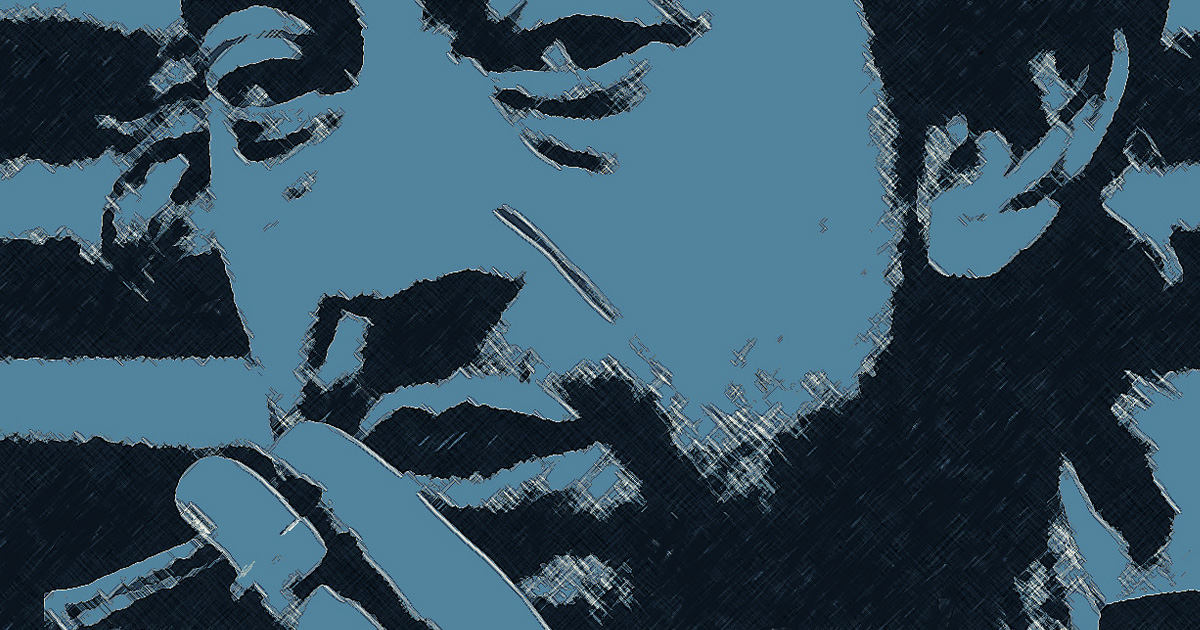
SERGE GAINSBOURG
ICON OF FRENCH POP CULTURE
April 2: Birthday
by Serge Gainsbourg
One of the most
original and provocative musicians of the
twentieth century.
Further on in his biography
The digital processing
of his portrait and the
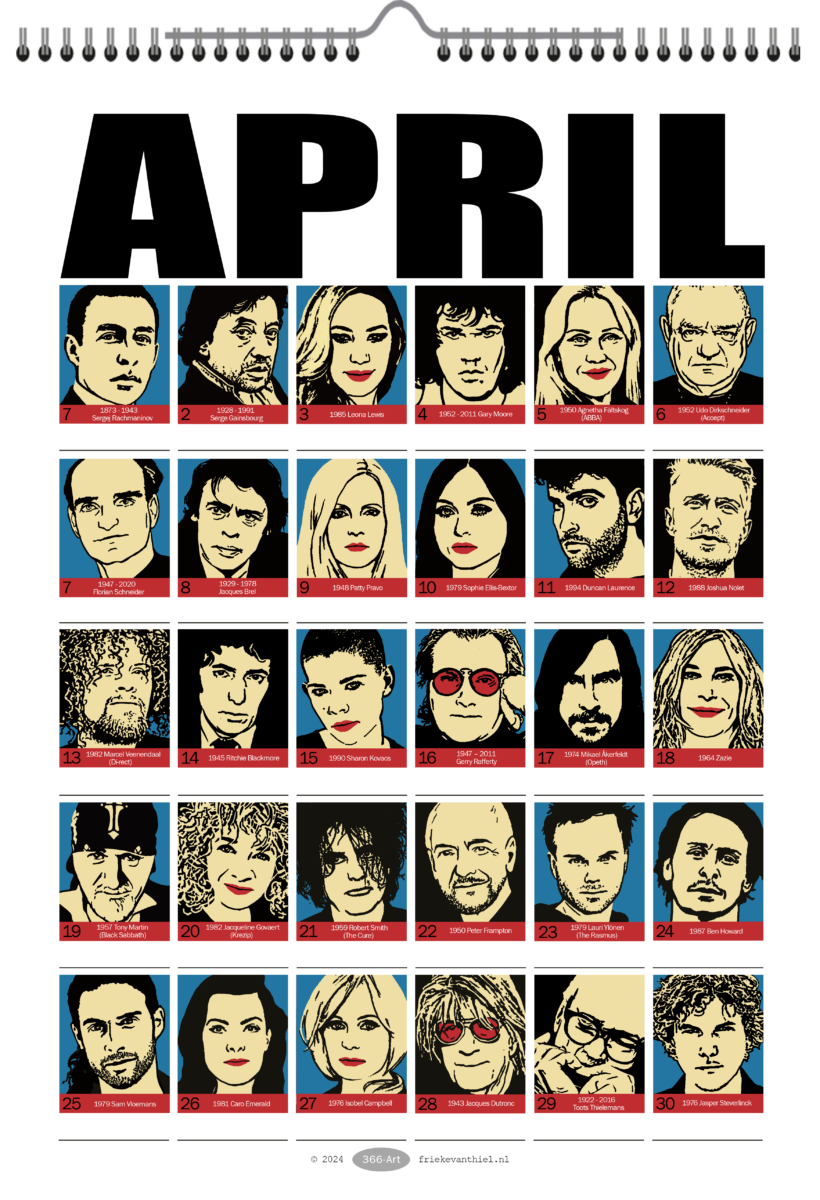
birthday calendar with
366 European Musicians,
are made by me,
Frieke van Thiel
Who was Serge Gainsbourg?
Serge Gainsbourg, born on April 2, 1928, as Lucien Ginsburg at the Hotel-Dieu on the Île de la Cité in Paris, was a French singer-songwriter, composer, poet, filmmaker, and actor. He is regarded worldwide as one of the most original and provocative musicians of the twentieth century. His work spanned more than four decades and encompassed styles such as chanson, jazz, yé-yé, pop, reggae, rock, funk, and electronica.
He grew up as the son of Russian-Jewish immigrants — Joseph and Olga Ginsburg — who fled to Paris via Istanbul after the Russian Revolution. His father, Joseph, was a classically trained pianist who earned his living in cabarets and casinos, which had a decisive influence on the musical development of Serge and his twin sister Liliane. During the German occupation of France in World War II, the family was forced to wear the mandatory Yellow Star, an experience that stayed with him for the rest of his life and helped shape his cynical worldview.
After the war, from 1945, he studied at the Beaux-Arts de Paris with the ambition to become a painter. Ultimately, he chose music, a choice that would have a major influence on French culture. He adopted the stage name “Serge Gainsbourg” in 1958: “Serge” because it sounded more Russian than Lucien, and “Gainsbourg” as a tribute to the English painter Thomas Gainsborough.
The Early Years: From Cabaret to Chanson (1954–1965)
In the 1950s, Gainsbourg worked as a pianist in Parisian cabarets and nightclubs — including the famous Milord l'Arsouille on the Rive Gauche — where he began writing his first songs. In 1958, he released his debut album. Du chant à la une! out, which revealed his complex and ironic view of love and life. His early work was strongly rooted in the tradition of the French chanson, but distinguished itself through its sharp, literary lyrics and unusual melodies.
His albums No. 2 (1959) and The Astonishing Serge Gainsbourg (1961) confirmed his reputation as a unique voice in French music. Songs like The Lilas Poincense, about a metro ticket inspector who dreams of freedom, and Woody jam demonstrate his ability to intertwine poetry with accessible music.
In 1965 he wrote Poupée de cire, poupée de son for the then 17-year-old France Gall, with whom she won the 1965 Eurovision Song Contest in Naples on March 20, 1965, with 32 points — not for France, but for Luxembourg. The song is often cited as the first true pop song to win Eurovision, and it marked the beginning of Gainsbourg's successful career as a songwriter for other artists.
International Breakthrough and Controversies (1966–1975)
In the second half of the 1960s, he achieved international breakthrough. His collaboration with Jane Birkin, whom he met in 1968 on the set of the film Slogan, led to the iconic song Je t'aime… moi non plus. The song, originally recorded in 1967 with Brigitte Bardot but not released at the request of her then-husband, Birkin (1969) became a worldwide hit and a controversial number 1 hit, despite radio bans and criticism from the Vatican.
Together, he and Birkin formed one of the most iconic couples of the seventies. They recorded multiple albums, including Jane Birkin/Serge Gainsbourg (1969) and Di doo dah (1973). Their relationship and collaboration made them symbols of the sexual revolution. Their daughter Charlotte Gainsbourg was born on April 22, 1971.
In March 1971, he released History of Melody Nelson out, considered by many to be his masterpiece. The concept album, with arrangements and co-compositions by Jean-Claude Vannier, lasts only about 28 minutes and grew into one of the most influential French albums ever.
Experimentation and Masterpieces (1976–1984)
Of L'Homme à tête de chou (1976) he pushed his boundaries again. The concept album combines funk, rock, and chanson in a dark story about jealousy and murder.
In early 1979, he traveled to Kingston, Jamaica, for Aux armes et cætera, a reggae version of La Marseillaise, recorded with Sly Dunbar and Robbie Shakespeare, the Jamaican band The Revolutionaries, and the I Threes — Rita Marley, Marcia Griffiths, and Judy Mowatt, Bob Marley's backing singers. The album led to fierce controversy and protests from far-right groups, including a canceled concert in Strasbourg on January 4, 1980, after paratroopers occupied the venue — Gainsbourg subsequently sang the original a cappella Marseillaise, whereupon the paratroopers jumped to attention.
Of Mauvaises nouvelles des étoiles (1981) he confirmed his status as an undeniable innovator. During this period, he also worked intensively with his daughter Charlotte Gainsbourg and his partner Bambou.
Gainsbarre: The Late Years (1984–1991)
In the eighties, he created his alter ego. Gainsbarre, a self-destructive version of himself that he portrayed in the media. His heavy drinking became legendary, as did his provocations on television, including burning a 500-franc banknote in March 1984 and his infamous remarks to Whitney Houston on April 5, 1986, during the live broadcast. Champs-Élysées by Michel Drucker.
Nevertheless, he remained musically active. Love on the Beat (1984) gave it a renewed, more modern sound. You're Under Arrest (1987) was his last studio album.
He died of a heart attack on March 2, 1991, in his apartment at 5 bis rue de Verneuil, in the 7th arrondissement of Paris, at the age of 62. He is buried in the Cimetière du Montparnasse. His home, covered with graffiti and flowers from fans, has become a place of pilgrimage.
Musical Legacy and Influence
Serge Gainsbourg's legacy is immense and extends far beyond the borders of France. During his career, he wrote more than 550 songs, which have been covered by various artists over 1,000 times. His ability to combine styles, write lyrics that are simultaneously vulgar and poetic, and break taboos while simultaneously writing perfect pop songs, makes him a unique figure in music history.
Artists such as Beck, Portishead, Pulp (Jarvis Cocker), Air, Placebo, and Tricky have acknowledged his influence. Histoire de Melody Nelson appears on virtually every serious list of the best albums of all time. His lyrics are studied as literature at French universities, and his songs are covered by artists from all over the world.
In January 2010, the biopic Gainsbourg (Vie héroïque) by director Joann Sfar was released, starring Éric Elmosnino — who won the César for Best Actor for his performance. On September 20, 2023, the Maison Gainsbourg opened in Paris, a museum complex on the rue de Verneuil that combines his intact home at No. 5 bis with a museum, bookstore, and piano bar (Le Gainsbarre) at No. 14. His daughter Charlotte Gainsbourg has kept his legacy alive by promoting his work and continuing his artistic spirit in her own career.
Serge Gainsbourg was, is, and will always remain a provocateur, artist, and genius: a man who pushed the boundaries of pop music further than anyone before or after him. His music, from the delicate chanson to the shocking reggae anthem, from psychedelic masterpieces to funky dance numbers, forms one of the richest and most diverse catalogues in the history of popular music.