

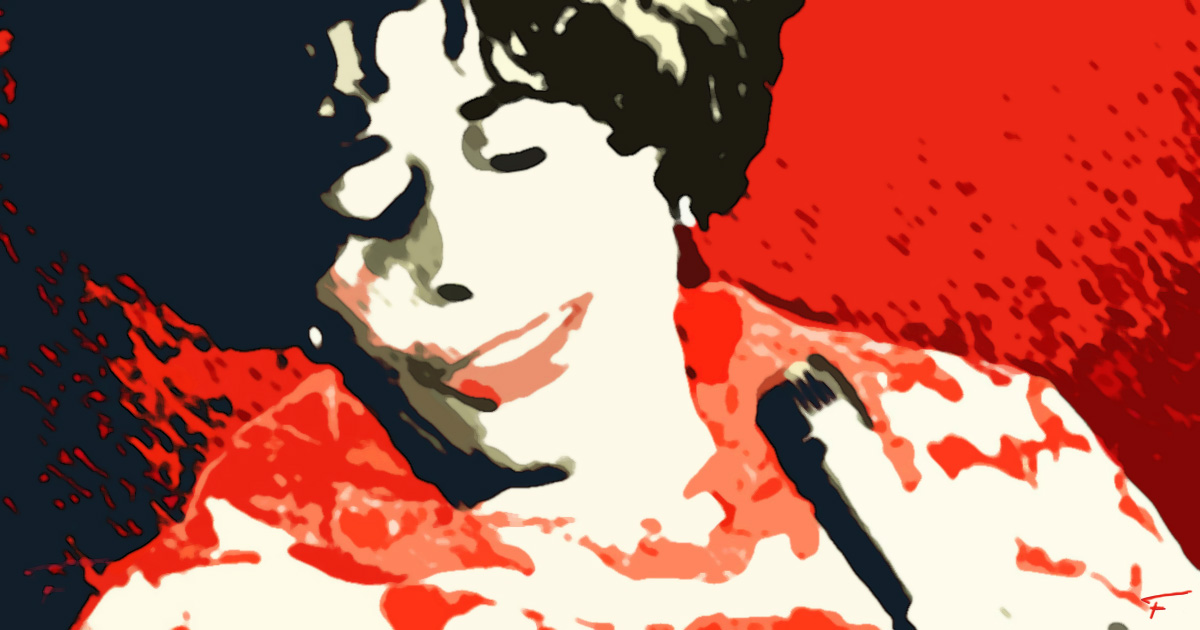
The first lady of song.
April 25 | Birthday of Ella Fitzgerald (1917–1996), one of the greatest jazz singers of all time! Her biography can be found further down in this blog. The digital edit of her portrait and the birthday calendar featuring 366 World Famous Musicians and 366 Legendary People are made by me, Frieke van Thiel.

Ella Fitzgerald: The Life and Music of the First Lady of Song
Ella Fitzgerald (April 25, 1917 – June 15, 1996) is regarded worldwide as one of the greatest jazz singers of all time. With her incredible vocal range, her perfect intonation, and her masterful command of scat technique, she managed to enchant generations of music lovers. From Harlem to Carnegie Hall, from Newport to Paris — wherever Ella sang, the air turned into music.
Early Years: A Difficult Start (1917–1934)
Ella Jane Fitzgerald was born on April 25, 1917, in Newport News, Virginia, as the daughter of William Ashland Fitzgerald, a truck driver from Blackstone, Virginia, and Temperance “Tempie” Williams. Her parents separated shortly after her birth. Ella moved with her mother to Yonkers, New York, where Tempie went to live with her new partner, the Portuguese immigrant Joseph da Silva. In 1923, her half-sister Frances was born.
Her childhood was marked by adversity: in 1932, her mother died as a result of injuries sustained in a car accident. Ella was briefly taken in by her aunt Virginia in Harlem, but after a difficult period — she played truant, got into trouble with the police, and worked as an errand boy for local gamblers — she was placed in the Riverdale Colored Orphan Asylum, and later in the strict New York State Training School for Girls in Hudson. She escaped from there, and young Ella ended up — homeless and alone — on the streets of Harlem during the Great Depression.
Yet she always carried a great talent within her. As a teenager, she danced on street corners in Harlem to earn some money, but it was the music that truly occupied her. She listened endlessly to the records of Connee Boswell, one of her great role models, and imitated her style down to the smallest detail.
The Breakthrough at the Apollo Theater (1934)
On November 21, 1934, seventeen-year-old Ella took her chance at the legendary Amateur Night at the Apollo Theater in Harlem. Although she had initially planned to dance, she was startled by the talent of the dance duo the Edwards Sisters, who performed before her, and at the last moment chose to sing. She sang two songs — “Judy” and “The Object of My Affection” — in the style of Connee Boswell, and silenced the audience. She won first prize, but the promised week-long performance at the Apollo was initially denied to her because, according to the theater management, she looked “too scruffy.”.
In January 1935, Ella subsequently got the chance to perform for a week with Tiny Bradshaw's orchestra. in the Harlem Opera House (not in the Savoy, as is sometimes said). Later that year she was by Bardu Ali introduced to bandleader Chick Webb. Webb, who was initially skeptical about her appearance, was eventually convinced by her voice and offered her a permanent position. Ella became the singer of the Chick Webb Orchestra, which performed regularly at the Savoy Ballroom in Harlem — and soon the absolute star of the ensemble.
A-Tisket, A-Tasket and Early Success (1938)
In 1938, Ella Fitzgerald achieved her first major commercial breakthrough with “A-Tisket, A-Tasket,” a song she co-wrote with Al Feldman (later known as Van Alexander) that was based on an old nursery rhyme. The record—recorded on May 2, 1938—became a massive hit and remained on the charts for seventeen weeks. Ella was suddenly a national celebrity.
After the death of Chick Webb in June 1939, Ella took over the leadership of the orchestra, which for a time was called “Ella Fitzgerald and Her Famous Orchestra.” She led the ensemble with visible charisma and self-confidence, even though she was only in her early twenties.
Decca Records and the Rise of the Jazz Diva (1942–1955)
In 1942, Ella left the orchestra to pursue a solo career, building on her contract with Decca Records. She recorded dozens of singles—from swing and pop to bebop—and collaborated with singers such as Louis Jordan, the Ink Spots, and Louis Armstrong. Her versatility was remarkable: she switched effortlessly from ballads to uptempo jazz numbers.
During this period, Ella also developed her renowned scat technique to great heights, partly influenced by her collaboration with Dizzy Gillespie's big band. Scat singing—in which the voice is used as an instrument of improvisation, with syllables instead of words—was not a new phenomenon, but Ella elevated it to an unprecedented level. Her scat passages were inimitable in complexity, speed, and musical logic.
🎵 Listen (live, 1966): “How High The Moon” — epic scat performance by Ella Fitzgerald
Verve Records and the Songbook Series: The Highlight (1956–1964)
The most influential chapter in Ella Fitzgerald's career began in 1956, when impresario and manager Norman Granz signed her to his new record label, Verve Records. Granz had already worked with Ella for years through his 'Jazz at the Philharmonic' concert series (with which she had been touring since 1949) and knew exactly what she was capable of.
Granz launched an ambitious project: the famous 'Songbook' series, in which Ella would record the works of the great American songwriters into full albums. The series comprised eight albums dedicated to composers such as Cole Porter (1956), Rodgers & Hart (1956), Duke Ellington (1957), Irving Berlin (1958), George & Ira Gershwin (1959), Harold Arlen (1961), Jerome Kern (1963), and Johnny Mercer (1964).
To this day, these recordings are considered the definitive interpretations of the 'Great American Songbook'. Ella's voice gave the classic songs a clarity, warmth, and musical depth that made them timeless. The Gershwin Songbook, recorded in collaboration with arranger Nelson Riddle, is regarded by many as her absolute magnum opus.
🎵 Listen (Gershwin): “Summertime” — Ella Fitzgerald (Verve, 1957)
Her collaboration with Louis Armstrong also produced timeless masterpieces, starting with the album Ella and Louis (1956).
🎵 Listen to (duet): “Cheek to Cheek” – Ella Fitzgerald & Louis Armstrong (1956)
Live performances and international recognition
Ella Fitzgerald was not just a studio musician — she was, above all, an impressive live performer. Her concerts at the Newport Jazz Festival, which first took place in 1954, were legendary. The live recordings “Ella Fitzgerald at the Opera House” (1957) and “Ella in Berlin: Mack the Knife” (1960) are among the most acclaimed live jazz albums ever made.
‘'Ella in Berlin' is particularly memorable: during a performance of 'Mack the Knife' at the Deutschlandhalle, Ella forgot the lyrics and improvised an entirely new version, complete with hilarious self-mockery. The recording won two Grammy Awards and shows how relaxed and masterful she was on stage.
🎵 Listen to (the legendary improvisation): “Mack The Knife” — live at the Deutschlandhalle, Berlin, 1960
🎵 Watch (rare video): “Summertime” — Ella Fitzgerald live in Berlin, 1968 (with the Tee Carson Trio)
Throughout the 1950s and 1960s, Ella toured the world tirelessly—from Carnegie Hall to European jazz festivals, from Tokyo to São Paulo. Despite the fact that, as a Black woman in the United States, she regularly faced segregation and discrimination, she continued to perform with a dignity and serenity that her audience never forgot. In 1955, she was even arrested in Houston, Texas, along with Dizzy Gillespie and Illinois Jacquet, in an action seen as a reprisal against Granz's civil rights activism.
Grammy Awards and Lasting Recognition
In total, Ella Fitzgerald received thirteen Grammy Awards, including a Grammy Lifetime Achievement Award in 1967. She won her first Grammys in 1958 for the album 'Ella Fitzgerald Sings the Irving Berlin Song Book' and for 'Ella Fitzgerald Sings the Duke Ellington Song Book'. She was the first African-American woman to win a Grammy.
In addition to her Grammys, Ella received countless other awards: the Presidential Medal of Freedom (1992), the National Medal of Arts (1987), honorary doctorates from, among others Yale University (1986) and Harvard University (1990), and the Kennedy Center Honor (1979). Her name is also on the Hollywood Walk of Fame.
The Later Years and Health Complaints (1970–1996)
In the 1970s and 1980s, Ella remained active, although her health imposed increasing limitations. She suffered from diabetes and underwent heart surgery in 1986. Her diabetes eventually led to the amputation of both legs below the knee in the early 1990s. Her last public performance took place at Carnegie Hall in New York in 1991.
On June 15, 1996, Ella Fitzgerald died at the age of 79 in Beverly Hills, California, due to complications from diabetes. The music world mourned on a large scale. Presidents, musicians, and millions of fans around the world lamented the loss of a unique talent.
Gift idea
You can order Ella Fitzgerald's digital edit from me as a print: poster, canvas, or dibond. Choose a size and optionally a color that suits your interior — a beautiful gift for a music or jazz lover, or for yourself (that is allowed too).
From €35. Send me a message via [contact] and we'll create something beautiful together. On request, I'll make a mockup so you can see how it will look on your wall.