

Master of Gold and the Viennese Fin de Siècle
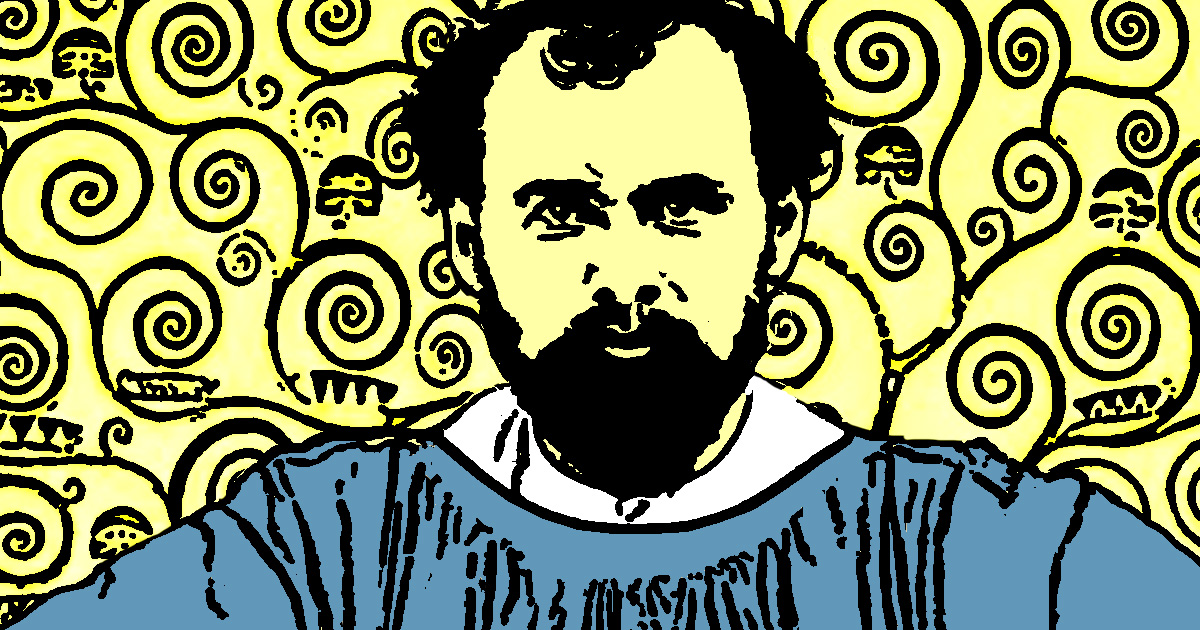
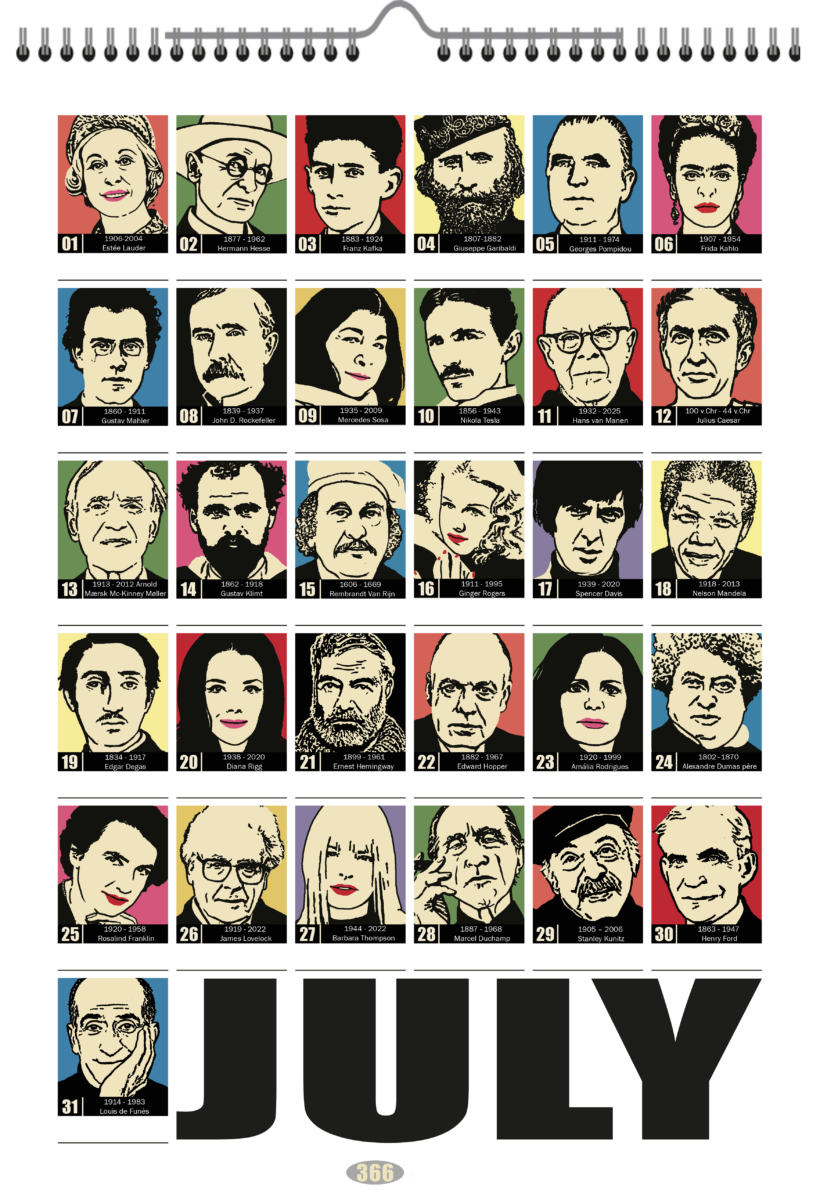
July 14 | Today is Gustav Klimt's birthday. With gold leaf, graceful patterns, and an unmistakable fascination with women, he created work that still touches people more than a hundred years later. His biography can be found further down in this blog. The digital edit featuring my interpretation of the Tree of Life in the background and the 366th birthday calendar with his portrait were created by me, Frieke van Thiel.
Who was Gustav Klimt?
Gustav Klimt was born on July 14, 1862, in Baumgarten, at the time a suburb of Vienna. He was the second of seven children in a family that was not financially well-off. His father, Ernst Klimt, was a gold engraver, a profession that left a lasting impression: the use of gold leaf would later become his son's trademark. Klimt rose to become the most important representative of Viennese Art Nouveau and founder and chairman of the Wiener Secession.
Youth and training
Klimt's talent for drawing was noticed early on. He was admitted to the Kunstgewerbeschule (the Vienna School of Applied Arts), where he received a classical, academic education. Together with his brother Ernst and fellow student Franz Matsch, he founded the 'Künstlercompagnie', a studio that soon secured renowned commissions. Between 1886 and 1892, the trio created murals for the Burgtheater and the Kunsthistorisches Museum in Vienna, among others, executed in a still fairly traditional, decorative style.
In 1892, both Klimt's father and his brother Ernst died shortly after one another, a period that deeply affected him personally and artistically. Shortly thereafter, he began to break away from the academic conventions in which he had been trained.
The Vienna Secession and the university scandal
In 1897, Klimt left the established Künstlerhaus and, together with Josef Hoffmann and Koloman Moser, among others, founded the Wiener Secession, with the motto 'Der Zeit ihre Kunst, der Kunst ihre Freiheit' (To time is art, to art is freedom). Klimt became the first chairman of this movement, which broke with classicism and focused on innovation in art and design.
His ceiling paintings for the University of Vienna, with the titles Philosophy, Medicine, and Jurisprudence, caused a great stir around 1900. The explicit nudity and the somber, symbolic representation of knowledge and science clashed with prevailing bourgeois taste. The commission was ultimately never installed in the university building; the works were later lost in a fire at the end of the Second World War.
The Golden Period
Around 1900, Klimt developed the style that would make him world-famous: the so-called Golden Period. Inspired by Byzantine mosaics he admired during a trip to Ravenna, he incorporated real gold leaf into his paintings. This period produced some of his most famous works, including:
- Judith I (1901)
- Portrait of Adele Bloch-Bauer I (1907), later known as 'the Austrian Mona Lisa'‘
- The Kiss (1907-1908), his most famous painting, now in the Belvedere in Vienna
- Danaë (1907-1908)
For the Secession, Klimt also created the Beethoven Frieze in 1902, a mural that paid tribute to the composer and which can still be seen in the Secession building in Vienna.
Klimt and the women in his life
The woman was Klimt's most important subject, both in his portraits of the Viennese bourgeoisie and in his more erotically charged work. He never married himself, but he did have several children with different women. His longest and most discussed relationship was with fashion designer Emilie Flöge, who was his life partner and muse for decades and possibly served as the model for The Kiss.
Late work and death
In his final years, Klimt's style shifted once again: the use of gold leaf gave way to bright colors and more natural forms, visible in works such as The Bride (1917-1918), which remained unfinished. On January 11, 1918, Klimt suffered a stroke, after which he became paralyzed on his right side. He died on February 6, 1918, in Vienna of pneumonia, a consequence of the Spanish flu, at the age of 55. He was buried in the Hietzinger Friedhof in Vienna.
Estate
Klimt left behind a considerable number of unfinished works, but his influence was anything but incomplete. He served as an important source of inspiration for younger artists such as Egon Schiele and Oskar Kokoschka, who further developed his fascination with the human body and the psyche in a more expressionist style.
Today, it possesses Belvedere in Vienna the largest Klimt collection in the world, with The Kiss as the absolute highlight. More background on his life can also be found at Wikipedia and on the site of Austria.info.
Gustav Klimt and the 366 birthday calendar
Just like with Frida Kahlo, Gustav Klimt's life shows how personal adversity and artistic breakthrough can go hand in hand. His birthday, July 14, is one of the 366 days that appear in the birthday calendar of 366calendar.com.
Finally
Gustav Klimt proves that art only truly comes to life when an artist dares to follow his own path. From the austere murals of his early years to the overwhelming gold leaf of The Kiss: his work remains a golden chapter in art history.
Would you like to have yourself or someone dear to you portrayed in the same style as Gustav Klimt's portrait? I specialize in creating portraits of people and animals, dynamic or posthumous. My hourly rate is €23.00 incl.
Prefer a ready-made print of this iconic artist herself? The digital edit of Frida Kahlo can also be ordered separately as a print: poster, canvas, or dibond. Choose a size and, if you like, a color that fits your interior — an original gift for a friend, or for yourself (that's allowed too). Starting from €35.
Send me a message via contact and we'll create something beautiful together. On request, I'll make a mockup so you can see how it will look on your wall.