

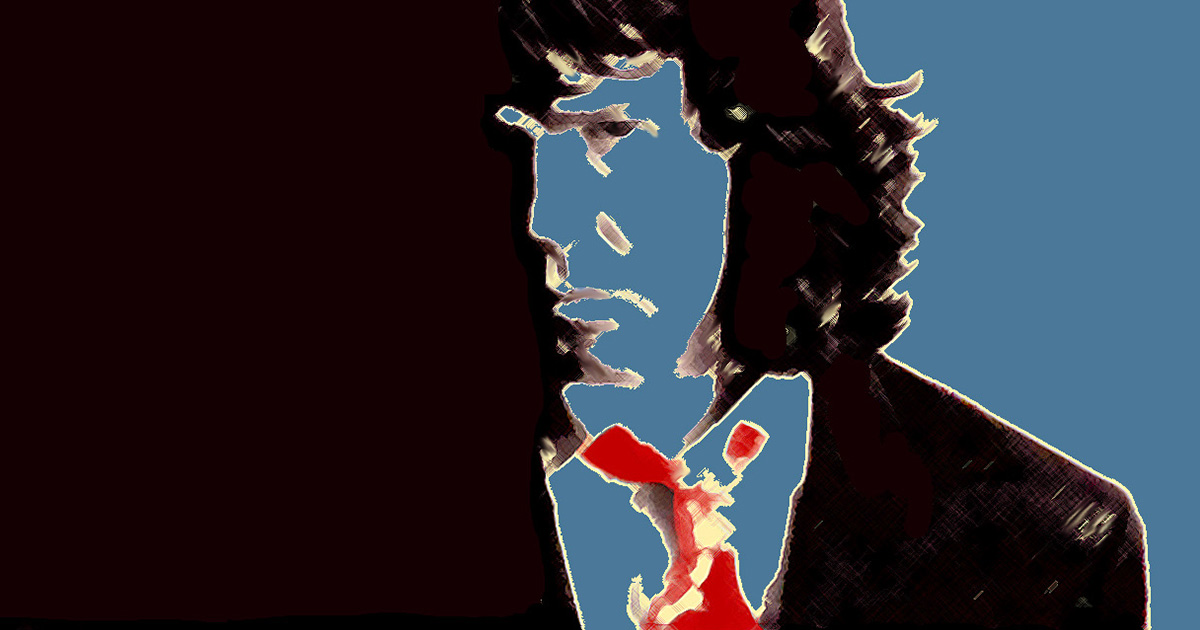
Legendary Northern Irish guitarist.
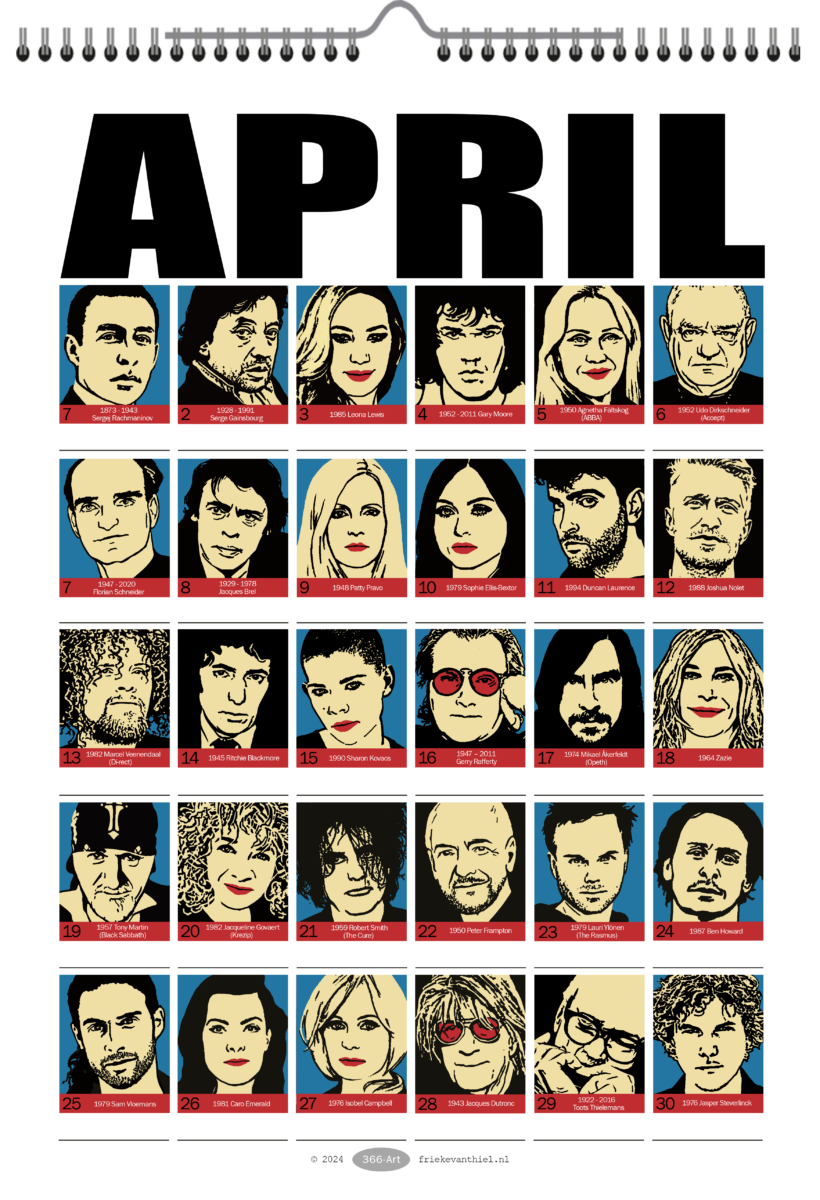
April 4 | Birthday of Gary Moore (1952–2011). The greatest and one of the most versatile guitarists in history. From hard rock to heartbreaking blues, Moore mastered every genre with an intensity that few musicians can match. Further down in this blog, his biography. The digital edit of his portrait and the birthday calendar with
366 European musicians are,
made by me, Frieke van Thiel
Gary Moore (4 April 1952 – 6 February 2011) was a Northern Irish guitarist, singer, and songwriter who is widely regarded as one of the greatest and most versatile guitarists in the history of rock music. His name has become synonymous with virtuoso guitar playing, heartfelt blues, and a tone so recognizable that it set him apart from virtually all his contemporaries. From hard rock to heartbreaking blues — Gary Moore mastered every genre with a depth and intensity that few musicians can match.
From his youth in Belfast to his international breakthrough with Thin Lizzy and his definitive triumph as a blues guitarist — the life of Gary Moore is the story of a man who not only played music, but lived it.
Early years: Belfast, 1952–1969
Robert William Gary Moore was born on April 4, 1952, in Belfast, Northern Ireland, into a musical family. His father, Bobby Moore, ran the Queen's Hall ballroom in Hollywood and encouraged Gary's talent. From a young age, he showed an extraordinary affinity for the guitar. Although Moore was naturally left-handed, he learned to play right-handed—a choice that many believe contributed to his unique playing style. The records of blues giants such as BB King, Albert King, and Freddie King, and particularly the work of Eric Clapton and Peter Green, would shape the young Gary Moore forever.
Moore was already playing guitar seriously at the age of twelve, and it soon became clear that his technique far surpassed that of his peers. By the age of sixteen, he was a regular fixture on the Belfast music circuit, playing in local bands such as The Beat Boys and The Method, and building a reputation as an exceptional talent.
Skid Row and the Breakthrough (1969–1971)
In 1969, Gary Moore—then only sixteen—moved to Dublin to join the Irish rock band Skid Row (not to be confused with the later American band of the same name). In Skid Row, Moore initially played alongside singer Phil Lynott, with whom he would build a deep friendship that would influence his entire career. However, Lynott was kicked out of the band as early as 1968 by bassist Brendan 'Brush' Shiels, after which Skid Row continued as a power trio with Shiels on bass and vocals and Noel 'Nollaig' Bridgeman on drums.
The band released two studio albums: the debut Skid (October 1970) and 34 Hours (1971). The latter album owes its name to the fact that it was recorded in just 34 hours. Moore's guitar playing immediately attracted the attention of critics. His ability to combine melody and technical virtuosity was already unmistakably present in this early period.
Thin Lizzy: brotherhood with Phil Lynott (1974–1979)
Gary Moore's collaboration with Thin Lizzy is one of the most admired chapters in Irish rock history. He replaced guitarist Eric Bell in January 1974 and contributed to the album Nightlife (1974). His contribution to Thin Lizzy was not only musical but also emotionally profound — the band and frontman Phil Lynott meant much more than just colleagues to Moore.
Moore left Thin Lizzy multiple times and returned each time, a pattern that reflected both his independent spirit and his deep loyalty to Lynott. His most memorable contribution to the band is the iconic guitar solo on 'Still in Love with You' from the album Nightlife (1974) — a breathtaking piece of guitar work that is considered one of the most beautiful solos in rock history. His contribution to the classic album Black Rose: A Rock Legend (1979) is also regarded as a highlight of the Thin Lizzy discography.
Solo career: hard rock and metal (1973–1989)
Alongside his work with Thin Lizzy, Gary Moore built an impressive solo career. His solo debut, Grinding Stone, was released as early as 1973, credited to The Gary Moore Band. However, his breakthrough as a solo artist came with Back on the Streets (1978), featuring the hit 'Parisienne Walkways' — a collaboration with Phil Lynott that grew into one of the most beloved rock ballads of all time. The melody is based on the jazz standard 'Blue Bossa' by Kenny Dorham, and the opening line 'I remember Paris in '49' refers to Lynott's birth year and his father, Cecil Parris. The song combines an irresistible melodic guitar theme with Lynott's distinctive voice and became an international hit.
In the 1980s, Moore focused on hard rock and heavy metal and released a series of successful albums. Corridors of Power (1982), Victims of the Future (1983), Run for Cover (1985), and Wild Frontier (1987) cemented his reputation as one of the genre's most technically gifted and emotionally compelling guitarists. Wild Frontier was a deeply personal album, inspired by his Irish roots and dedicated to his great friend Phil Lynott.
The death of Phil Lynott on January 4, 1986, affected Moore deeply. The two were more than colleagues — they were brothers in music and spirit. That loss is palpable in the music of Wild Frontier (1987) and its sequel After the War (1989), albums steeped in grief, nostalgia, and strength. The track 'Johnny Boy' on Wild Frontier is a direct ode to Lynott; the back cover simply bears the dedication 'For Philip'.
Still Got the Blues (1990)
In 1990, Gary Moore surprised the music world with a radical yet deeply sincere turnaround: he released Still Got the Blues, an album with which he completely transformed himself into a blues guitarist. The album was a love letter to his major influences — BB King, Albert King, and Peter Green — and featured guest appearances by Albert King, Albert Collins, and George Harrison, among others.
Still Got the Blues became an artistic as well as a commercial triumph, and went platinum in several countries. The title track grew into a timeless blues anthem, a song that forever etched Moore's name into blues history. His tone, his vibrato, his timing—everything came together perfectly on this album. It proved that Gary Moore was not only a technically masterful guitarist, but also an artist with a true blues heart.
The Blues Era: 1992–2010
After the success of Still Got the Blues, Gary Moore remained true to the blues. After Hours (1992) was a deeper, more beautiful, and more personal blues album. Blues for Greeny (1995) was a tribute to his great hero Peter Green, founder of Fleetwood Mac, featuring covers of classic Peter Green songs, played on Green's own legendary Les Paul guitar.
Later albums such as Dark Days in Paradise (1997) and A Different Beat (1999) experimented with electronic influences, but Moore always returned to his blues roots. Power of the Blues (2004) and Close as You Get (2007) cemented his position as one of the most respected blues guitarists in the world. His live performances from this period were praised for their intensity, emotional depth, and technical perfection.
Gary Moore's guitars
Gary Moore was not just a guitarist — he was a connoisseur of guitars. His most iconic instrument was a 1959 Gibson Les Paul Standard, a guitar with a legendary history. Moore bought the guitar around 1970 from his friend Peter Green and used it on countless recordings and live performances. This 'Greeny' Les Paul, as the instrument became known, features a unique pickup modification (an inverted neck pickup) that produces a characteristic, almost nasal 'out-of-phase' sound. In 2006, Moore sold the guitar to dealer Phil Winfield due to financial difficulties; the guitar eventually ended up in the hands of Kirk Hammett of Metallica in 2014 for a reported sum of less than two million dollars.
In addition to the Greeny, Moore also used other Les Pauls, Fender Stratocasters, and custom-built instruments. His tone—warm, full, and deeply expressive—was the result of the interplay between his guitar, his amplifier, and, above all, his fingers. Moore played with an unmistakable aggression mixed with tenderness that defined his unique musical voice.
Death and inheritance
On 6 February 2011, Gary Moore died unexpectedly in his sleep at the Kempinski Hotel Bahia in Estepona, Spain. He was 58 years old. The cause of death was a heart attack; according to reports in The Daily Telegraph, a significantly elevated blood alcohol level of 0.381 TBP played a role. His passing came as a shock to the music world, and tributes poured in from all sides — from Bryan Adams and Brian May to Kirk Hammett, Tony Iommi, and Bob Geldof, who called him 'without a doubt one of the great Irish bluesmen'. Moore was buried in a private ceremony at St Margaret's Cemetery in Rottingdean, near Brighton.
Gary Moore left behind a musical legacy that is difficult to overestimate. As a guitarist, composer, and performer, he was one of the most complete musicians of his generation. His influence is audible in the playing of countless guitarists who came after him—from Joe Bonamassa to John Sykes, from Kirk Hammett to Slash. His albums remain bestsellers, and his guitar solos are still played and studied all over the world.
Gary Moore was more than a guitarist. He was a storyteller, an emotional force, an artist who poured his soul into every note. His music will live on as long as there are people who love real, heartfelt guitar music.
Discography: highlights
- Grinding Stone (1973) – solo debut as The Gary Moore Band
- Back on the Streets (1978) – solo breakthrough with 'Parisienne Walkways'‘
- Corridors of Power (1982) – hard rock masterpiece
- Victims of the Future (1983) – technical guitar extravaganza
- Run for Cover (1985) – with the hit 'Out in the Fields' (with Phil Lynott)
- Wild Frontier (1987) – personal and Irish, dedicated to Phil Lynott
- After the War (1989) – last hard rock album
- Still Got the Blues (1990) – the blues album that redefined his career
- After Hours (1992) – deep and melancholic blues masterpiece
- Blues for Greeny (1995) – tribute to Peter Green
- Close as You Get (2007) – late-career blues classic
- Bad for You Baby (2008) – his last studio album
YouTube videos
A selection of official and historical recordings showcasing Gary Moore's versatility:
Classic ballads and blues
- Still Got the Blues (official music video, 1990) — https://www.youtube.com/watch?v=t1kHdIU8Uek
- Still Got the Blues (live, Montreux Jazz Festival 1997) — https://www.youtube.com/watch?v=HtmV2I4Fl7Q
- Parisienne Walkways (live, Royal Albert Hall 1992) — https://www.youtube.com/watch?v=tnwIpgSqjXE
- Parisienne Walkways (live, Montreux 2010 — one of his last performances) — https://www.youtube.com/watch?v=e356RkTWUUM
Thin Lizzy and Phil Lynott
- Thin Lizzy & Gary Moore — Still in Love with You (live tribute, One Night in Dublin 2005) — https://www.youtube.com/watch?v=xulcsArPlF0
Hard rock era
- Out in the Fields (Gary Moore & Phil Lynott, 1985) — https://www.youtube.com/watch?v=hIiuv6PwkdQ
Blues for Greeny and later blues
- Gary Moore — Still Got the Blues (live in London, 2009) — https://www.youtube.com/watch?v=iZ6lLIK-_Eg
“He played the blues like his life depended on it — because it did.”
Gift idea
You can order Gary Moore's digital edit from me as a print: poster, canvas, or dibond. Choose a size and optionally a color that suits your interior — An original gift for a fan, music or guitar lover, or for yourself (that is allowed too). From €35. Send me a message via [contact] and we'll create something beautiful together. On request, I'll make a mockup so you can see how it will look on your wall.