

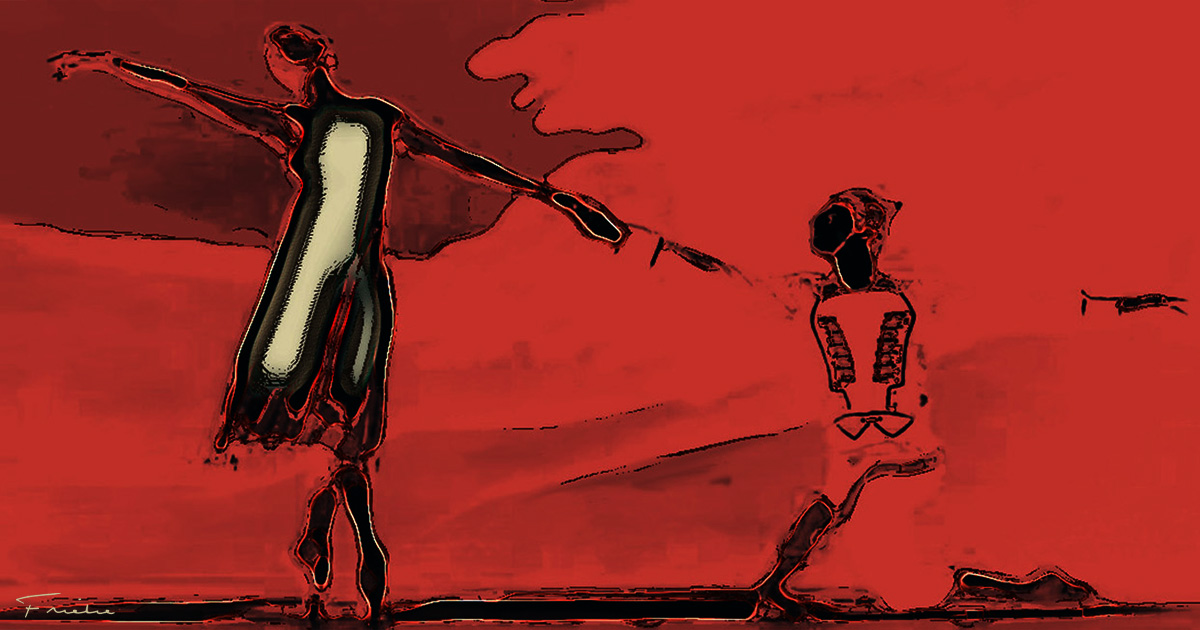
TSJAIKOVSKY | THE KING OF BALLET
May 7: Birthday of Pyotr Ilyich Tchaikovsky, the most beloved composer of all time. Without him, swans would be just birds and nutcrackers merely kitchen utensils. His biography can be found further down in this blog.
The digital edit of the Nutcracker and the birthday calendars featuring 366 musical and legendary portraits were created by me, Frieke van Thiel.

The Life and Music of Russia's Greatest Composer: Pyotr Ilyich Tchaikovsky
Pyotr Ilyich Tchaikovsky (1840–1893) is without a doubt the most famous Russian composer of all time. His music is rich in emotion, melodic beauty, and dramatic power. Generations of listeners around the world have been moved by it. Think of the fairytale-like Swan Lake or the powerful First Piano Concerto. Tchaikovsky's compositions are among the most played and beloved works in the classical music repertoire.
Tchaikovsky connected the romantic musical traditions of Western Europe with the folk music and soul of Russia. He formed a bridge between two worlds. On the one hand stood international music culture, on the other the rich Russian national identity. This makes his music unique and timeless to this day.
Early Life and Childhood (1840–1861)
Pyotr Ilyich Tchaikovsky was born on May 7, 1840, in Votkinsk, a small industrial town in the Vyatka Governorate of Russia (in present-day Udmurtia). His father, Ilya Petrovich Tchaikovsky, was a mining engineer and director of the Kamsko-Votkinsk iron foundry. His mother, Alexandra Andreyevna (née Assier), had partial Franco-German roots. She played a major role in her son's early musical development.
Even at a very young age, young Pyotr showed a remarkable talent for music. He learned to play the piano from his French governess, Fanny Dürbach. Later, he received piano lessons from professional teachers. His hearing was so sensitive that he would wake up crying at night after hearing a piece of music. The melodies simply would not let him go.
In 1850, the family moved to Saint Petersburg. There, Tchaikovsky attended the Imperial School of Law. Despite his legal education, music remained his greatest passion. In 1854, his mother died of cholera. This traumatic event would stay with him for the rest of his life and led him to deepen his musical studies. In 1859, he graduated and worked for some time as a civil servant at the Ministry of Justice.
The Path to the Conservatory (1861–1865)
In 1861, Tchaikovsky began taking music theory lessons at the Russian Music Society in Saint Petersburg. The renowned pianist and composer Anton Rubinstein had founded this society in 1859. Here he discovered his true calling. In 1862, he enrolled as one of the first students at the newly established Saint Petersburg Conservatory. There he studied composition, harmony, and orchestration under Anton Rubinstein himself.
In December 1865, Tchaikovsky obtained his diploma with a large silver medal. At the time, this was the highest distinction of the conservatory. In early 1866, he moved to Moscow. At the invitation of Nikolai Rubinstein, Anton's brother, he accepted an appointment as a teacher of harmony at the newly founded Moscow Conservatory. This marked the beginning of a crucial period in his life. It was in Moscow that the first compositions were created that would bring him international fame.
The Musical Genius: Tchaikovsky's Major Works
Tchaikovsky was a remarkably prolific composer. In his relatively brief life — he died at the age of 53 — he produced a vast body of work encompassing virtually every musical genre: six complete symphonies, operas, piano music, chamber music, songs, and the legendary ballets with which his name is forever associated.
The Three Great Ballets
Swan Lake (1875–1876)
Swan Lake (Russian: Лебединое озеро, Lebedinoye Ozero) is perhaps the most famous ballet in the world. Tchaikovsky composed the score on commission from the Bolshoi Theatre in Moscow. The story of Princess Odette, transformed into a swan by a sorcerer, and her love for Prince Siegfried, is a timeless fairy tale that has captivated the hearts of millions around the globe.
The premiere on March 4, 1877 (February 20, Old Style), however, was not a great success. It was only after the composer's death, in the revised 1895 production by Marius Petipa and Lev Ivanov (with revisions to the score by Riccardo Drigo), that the ballet achieved the triumphant status it holds today. The celebrated Swan Theme, the adagio, and the white acts are considered pinnacles of balletic composition. A full performance by the Bolshoi Ballet (1989) is available online; another beautiful version features Svetlana Zakharova as Odette/Odile (Bolshoi 2015)and for those wishing to listen to the music alone, there is a full recording by the Bolshoi Orchestra (2 hours).
The Sleeping Beauty (1888–1889)
Sleeping Beauty — in Russian Spjasjtsjaja Krasavitsa is a ballet in a prologue and three acts, commissioned by Ivan Vsevolozhsky, director of the Imperial Theatres. Tchaikovsky worked in close collaboration with choreographer Marius Petipa in creating this monumental work.
The premiere at the Mariinsky Theatre in Saint Petersburg on January 15, 1890, was a resounding success. The score of The Sleeping Beauty is considered one of the most richly orchestrated ballets ever written. The theme of Aurora and the music of the Lilac Fairy have become iconic in the world of classical music. A full performance by the Royal Ballet featuring Petipa's original choreography offers a wonderful introduction; a more recent performance of the Nureyev Festival 2022 with Ekaterina Krysanova as Aurora is also available online.
The Nutcracker (1892)
The Nutcracker (Russian: Shchelkounchik) is based on a story by E.T.A. Hoffmann (in the adaptation by Alexandre Dumas père) and was composed as part of a double bill with the opera Iolanta. The premiere took place on December 18, 1892, at the Mariinsky Theatre in Saint Petersburg.
Initially the ballet received mixed reviews, but The Nutcracker Suite — which Tchaikovsky assembled from the most accessible sections of the score and premiered as early as March 1892 — became an immediate popular success. Today, The Nutcracker is the most frequently performed ballet in the world, and in many countries it has become an inseparable part of the Christmas tradition. The legendary recording by the Berliner Philharmoniker conducted by Rostropovich stands as a reference for the suite. Individual movements are also available online: Flower Waltz (Karajan), Russian Dance / Trepak (Rattle) and Dance of the Sugar Fairy (Rostropovich).
The Six Symphonies
Tchaikovsky composed six complete symphonies, each occupying a distinctive place in the symphonic repertoire (in addition to the programmatic Manfred, Op. 58). While the first three (1866–1875) are relatively lesser known, the Fourth, Fifth, and Sixth Symphonies are universally regarded as supreme masterpieces of the Romantic era.
The Fourth Symphony in F minor (1877–1878), dedicated to his patroness Nadezhda von Meck, reflects the inner struggle and fatalism that pervaded Tchaikovsky's life. The Fifth Symphony in E minor (1888) explores similar themes of fate and submission, yet concludes in a triumphant major key. The Sixth Symphony in B minor, nicknamed Pathétique (1893), is his musical testament: a profoundly felt, tragic masterwork that he conducted just nine days before his death. The finale — a slow, fading Adagio lamentoso — is among the most moving musical utterances in the entire Western classical tradition. The legendary recordings by Herbert von Karajan with the Vienna Philharmonic and with the Berlin Philharmonic (1971) stand as reference performances of this work.
Piano and Violin Concertos
Tchaikovsky's First Piano Concerto in B-flat minor (1874–1875) is one of the most performed and beloved piano concertos in the world. The opening theme — a sweeping, broadly stated melody above the piano's powerful chords — is instantly recognizable and is regarded globally as a symbol of Romantic piano music. Remarkably, the work was initially rejected by Nikolai Rubinstein as 'unplayable.' Its world premiere ultimately took place on October 25, 1875 — not in Russia, but in Boston (USA) — with Hans von Bülow as soloist and B.J. Lang conducting. The concerto soon achieved international triumphs, and even Rubinstein later became an ardent champion of the work. The legendary performance by Martha Argerich with Charles Dutoit ranks among the finest recordings; Daniil Trifonov at the Tchaikovsky Competition also delivers a sublime interpretation.
The Violin Concerto in D major (1878), composed in Clarens (Switzerland) where Tchaikovsky was recovering from his disastrous marriage, suffered a similar fate: the virtuoso Leopold Auer — to whom the work had originally been dedicated — declared it unplayable, causing the planned premiere of March 1879 to be cancelled. It was only on December 4, 1881, that the concerto received its premiere in Vienna by violinist Adolph Brodsky with the Vienna Philharmonic conducted by Hans Richter. Although the formidable critic Eduard Hanslick savaged the performance, the work grew to become one of the most performed violin concertos ever written. The interpretation by Janine Jansen with Mikhail Pletnev at the Verbier Festival is a highlight; the performance by Hilary Hahn is also widely praised for its technical perfection and lyricism.
Operas
Although Tchaikovsky's ballets and symphonies are his most celebrated works, he also composed ten complete operas. Eugene Onegin (composed 1877–1878, premiered on March 29, 1879 at the Maly Theatre in Moscow, performed by students of the Moscow Conservatory), based on Alexander Pushkin's novel in verse, and The Queen of Spades (1890) are considered the crown jewels of the Russian operatic repertoire. Eugene Onegin contains Tatiana's Letter Scene, one of the finest dramatic soprano arias in the operatic literature. The masterful interpretation by Anna Netrebko at the Metropolitan Opera under Valery Gergiev is available online.
Personal Life and Inner Struggles
Tchaikovsky's personal life was complicated. To this day, musicologists still discuss this subject. He struggled with his homosexuality in a society that did not tolerate it. In July 1877, he married Antonina Miljukova, a former student who had fallen in love with him. However, the marriage turned into a disaster. It fell apart within a few weeks, and in October 1877, they separated for good. Incidentally, they never formally dissolved the marriage.
One of the most extraordinary relationships in Tchaikovsky's life was with his patron Nadezhda von Meck. This wealthy widow adored his music. For thirteen years (1877–1890), she provided him with a substantial annual income. This enabled him to resign his teaching position at the conservatory and devote himself entirely to composing. Remarkably, the two agreed never to meet in person. Their relationship consisted solely of an extensive correspondence of more than a thousand letters. In 1890, Von Meck suddenly severed all contact and financial support.
International Tours and World Fame
In the 1880s, Tchaikovsky gained international fame. He traveled throughout Europe and conducted his own works in major concert halls. In May 1891, he visited the United States for the opening of Carnegie Hall in New York. On the opening night of May 5, 1891, he conducted his Marche solenelle. During the five-day opening festival, he performed a total of five of his works. The audience received him with great enthusiasm. American listeners embraced his music just as eagerly as their counterparts in Russia and Western Europe. The Carnegie Hall Archives posted historical video documentation of this online.
The Mysterious Death of Tchaikovsky (1893)
On November 6, 1893, Pyotr Ilyich Tchaikovsky died in Saint Petersburg. His death came just nine days after the triumphant premiere of his Sixth Symphony. According to the official account, cholera was the cause of death. He is said to have contracted the disease by drinking unboiled water during a cholera epidemic. Tchaikovsky was 53 years old.
However, there is controversy regarding the exact circumstances of his death. In the late 20th century, some musicologists and historians argued that it may have been suicide. According to this theory, third parties may have incited him to do so to protect his personal life. Other researchers, including Britannica, consider that theory insufficiently substantiated. To this day, the exact cause of death has not been established with certainty. It remains one of the most discussed mysteries in music history.
Tchaikovsky's Enduring Legacy
The musical legacy of Pyotr Ilyich Tchaikovsky is invaluable. The best orchestras, opera companies, and ballet companies in the world perform his compositions. The Three Ballets Swan Lake, The Sleeping Beauty and The Nutcracker belong to the most performed plays in history.
Tchaikovsky opened the door for generations of Russian composers who came after him. Among them are Sergei Rachmaninov, Igor Stravinsky, and Dmitri Shostakovich. He managed to articulate deep human emotions in musical language: love, sorrow, triumph, and tragedy. As a result, his work remains universal and timeless.
In Russia, Tchaikovsky is regarded as a national icon to this day. The International Tchaikovsky Competition takes place in Moscow every four years. It bears his name and is one of the most prestigious music competitions in the world. His birthplace in Votkinsk now serves as a museum, as does his last residence in Klin, not far from Moscow.
Tchaikovsky mainstream
Tchaikovsky's music has also left an enormous mark outside the concert hall. His themes can be heard in countless films, television series, commercials, and video games. The Disney film Sleeping Beauty ballet (1959) relies musically almost entirely on the music of The Sleeping Beauty. The Nutcracker is synonymous worldwide with Christmas and winter holidays. The 1812-Overture (1880) is by now an integral part of American Independence Day celebrations.
To this day, his music resonates in ice hockey arenas, sports galas, fashion shows, and concert halls all over the world. The Wals of Flowers out The Nutcracker, the Swan Laketheme, and the finale of the First Piano Concerto live on in the collective memory of humanity.
Gift idea
This image, my interpretation of Tchaikovsky's Nutcracker, You can order this from me as a print: poster, canvas, or Dibond. Choose a size and optionally a color that suits your interior — a beautiful gift for a music lover, or for yourself (that is allowed too).
From €35. Send me a message via [contact] and we will make something beautiful out of it. Upon request, I will create a mockup so you can see how it looks on your wall.