

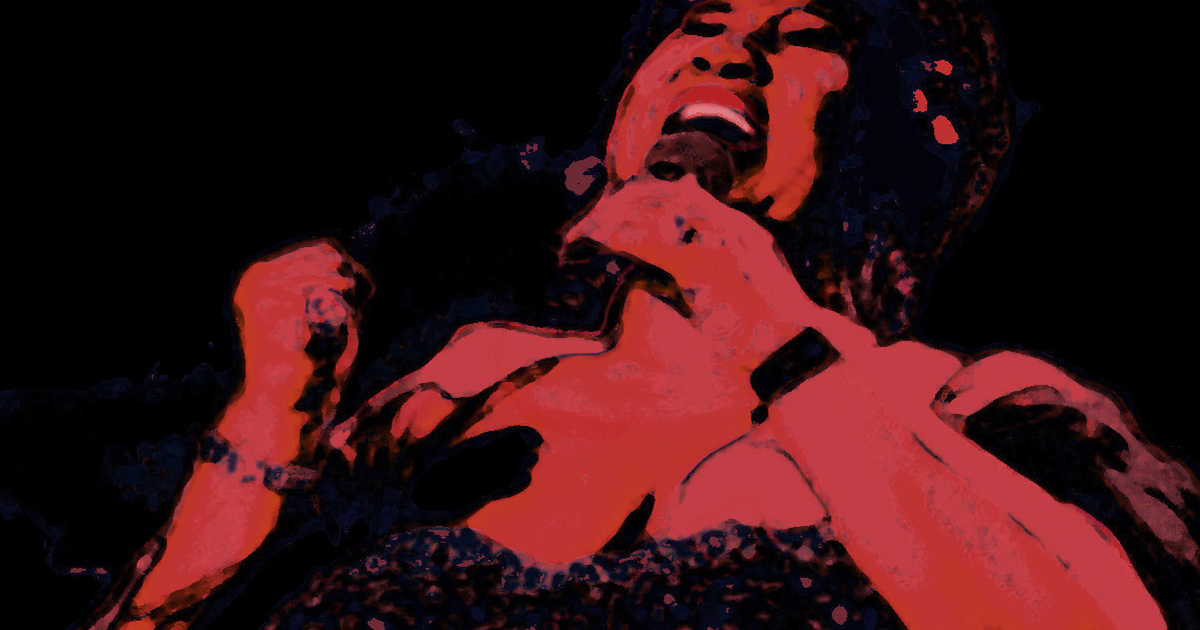
Queen of Soul
March 25 | The birthday of Aretha Franklin (1942–2018), the day the music world pauses to remember one of the most influential artists of all time. Aretha Franklin effortlessly mastered every genre: from gospel to R&B, from pop to jazz. Her voice — described by many as a force of nature — touched millions of people around the world for generations. You can read her full biography further down in this blog. The digital editing of her portrait and the 366 birthday calendars were made by me, Frieke.

Early life and childhood in Detroit
Aretha Franklin was born on March 25, 1942, in Memphis, Tennessee, but grew up in Detroit, Michigan. Her father, the renowned minister and civil rights activist Clarence LaVaughn (CL) Franklin, played a defining role in her early musical development. In the church where he preached—the New Bethel Baptist Church in Detroit—Aretha sang as a choir member from the age of four.
The Franklin family regularly received visits from famous musicians and civil rights leaders, such as Mahalia Jackson, Sam Cooke, Dinah Washington, and later Martin Luther King Jr. These encounters formed the fertile ground upon which Aretha's talent could flourish. At the age of twelve, she recorded her first gospel record in her father's church, released through a small local label.
However, the young Aretha's life was not without setbacks. Her mother, Barbara Siggers Franklin, left the family when Aretha was six years old and passed away a few years later. As a teenager, Aretha became pregnant and had two sons. Yet she continued to follow her musical calling, driven by an unwavering faith and boundless talent.
Breakthrough at Columbia Records and the move to Atlantic
In 1960, eighteen-year-old Aretha Franklin signed a contract with Columbia Records at the urging of talent scout John Hammond, who had previously also discovered Billie Holiday and Bob Dylan. Although her years at Columbia were commercially disappointing—the label positioned her as a jazz and pop singer, whereas her true strength lay in gospel and soul—she demonstrated her musical versatility here as well.
The real breakthrough came in 1967 when she switched to Atlantic Records. Producer Jerry Wexler immediately understood what Aretha needed: freedom to be herself. At the Muscle Shoals Sound Studio in Alabama, she recorded her first Atlantic single: ‘'I Never Loved a Man (The Way I Love You)'’. The song became an instant hit and heralded the beginning of an unprecedented artistic flourishing.
Respect: the song that defined a movement
No song symbolizes Aretha Franklin's artistic power and social significance better than ‘Respect’. Originally written and recorded by Otis Redding in 1965, Aretha transformed the song in 1967 into an anthem for both the women's movement and the civil rights movement. Her version is ranked number five in Rolling Stone’list of the 500 best songs of all time.
The text — full of demanding, confident language — and its compelling performance made ‘Respect’ into a powerful statement. The addition of the iconic 'RESPEC-T' spelling and the backing vocals by her sisters Erma and Carolyn gave the song an extra dimension. It reached the number one position on both the R&B and pop charts and launched Aretha as an international superstar in one fell swoop.
🎬 Watch: ‘'Respect' — Live in Amsterdam, Concertgebouw 1968
The Golden Years: Discography and Hit Singles (1967–1974)
Between 1967 and 1974, Aretha Franklin experienced her most prolific artistic period. In just seven years, she released a series of albums that are each considered classics.
I Never Loved a Man the Way I Love You (1967)
Her debut album on Atlantic Records is considered a milestone in soul and R&B music. In addition to the title single, it also contains ‘'Do Right Woman, Do Right Man'’ and a compelling version of ‘'(You Make Me Feel Like) A Natural Woman'’, written by Carole King and Gerry Goffin.
🎬 Watch: ‘'A Natural Woman' — Live at the Kennedy Center Honors, 2015 (iconic performance!)
Lady Soul (1968)
With songs like ‘'Chain of Fools'’, ‘'(Sweet Sweet Baby) Since You've Been Gone'’ and ‘Ain't No Way’ Aretha confirmed her position as the undisputed Queen of Soul. The album reached number two on the Billboard 200 and remained on the charts for months.
🎬 Look at: ‘'Chain of Fools / Respect' — Live 1968 (archive)
Spirit in the Dark (1970)
This album showed a deeper connection to Aretha's gospel roots. The title track is a hypnotic, almost ritualistic musical experience that demonstrates her ability to transform a room into a church community.
🎬 Watch: Full live concert Fillmore West, 1971 — including 'Dr. Feelgood'‘
Amazing Grace (1972)
Considered by many to be the best live gospel album of all time: a double live gospel album recorded at the New Temple Missionary Baptist Church in Los Angeles. It became the best-selling album of her entire career. The recordings were also captured on video, but the accompanying film was not released until 2018 — the year of Aretha's passing.
🎬 Look at: ‘Amazing Grace’ — Live 1972, New Temple Missionary Baptist Church
Civil rights and social engagement
Aretha Franklin was not a passive symbol of the civil rights movement — she was an active participant. She performed at countless benefit concerts for the Southern Christian Leadership Conference (SCLC) and was personally close to Martin Luther King Jr., whose funeral she attended and at whose funeral ceremony she sang.
After the assassination of King in 1968, Aretha publicly declared that she would pay the bail for Angela Davis, the activist who was arrested in 1970. 'Angela Davis knows that black women stand behind her,' Aretha said in Jet Magazine. 'I am standing up for her here because it is so in my heart.' This commitment made her not merely an entertainer, but a cultural force who used her platform to make a difference.
A renaissance: the eighties and nineties
After a relatively quieter period in the late seventies, Aretha made an impressive comeback in 1982 with the album Jump to It, produced by Luther Vandross. The collaboration ushered in a new, funky phase in her career.
In 1985 she released Who's Zoomin' Who? out, which brought her back into the mainstream top charts. The title song and ‘Freeway of Love’ became big hits. That year she also won a Grammy Award for ‘Freeway of Love’ in the Best Female R&B Vocal Performance category.
In 1987, she recorded the duet. ‘'I Knew You Were Waiting (For Me)'’ up with George Michael, which reached the number one position worldwide. And who would have ever thought that the Queen of Soul would sing opera? In 1998, she stepped in for a sick Luciano Pavarotti at the Grammy Awards on just a few hours' notice — and did incredibly well.
🎬 Watch: ‘'Nessun Dorma' — Live at the Grammy Awards, 1998 (legendary!)
Grammys, awards and legacy
Aretha Franklin received 18 Grammy Awards during her lifetime, including a Grammy Lifetime Achievement Award in 1994. In 1987, she became the first woman to be inducted into the Rock and Roll Hall of Fame. She received the Presidential Medal of Freedom from President George W. Bush in 2005 and the Presidential Medal of Honor from President Barack Obama in 2009.
At the inauguration of Barack Obama as the 44th president of the United States in 2009, Aretha sang. ‘My Country, 'Tis of Thee‘ — a historic moment that symbolized the connection between the civil rights struggle of the 1960s and the historic election of the first African American president.
Rolling Stone Magazine placed her at number one on their list of the 100 Greatest Singers of All Time. VH1 named her the greatest female musician of all time.
Private life and personality
Despite her enormous public presence, Aretha Franklin was relatively withdrawn in her private life. She married twice: first to Ted White (1961–1969) and later to actor Glynn Turman (1978–1984). She had four sons: Clarence, Edward, Ted White Jr., and Kecalf.
Aretha was known for her passion for cooking — her fried chicken was legendary among friends and colleagues. She was also notorious for her fear of flying and for much of her life traveled only by car or train. Her last major public appearance took place in November 2017, at the opening of the Chase Center in Detroit.
The end of an era: death and inheritance
On August 16, 2018, Aretha Franklin died of pancreatic cancer at the age of 76 in her home in Detroit. Her passing was mourned worldwide. Government leaders, musicians, and millions of fans paid tribute to her. The city of Detroit displayed her casket for two days at the Charles H. Wright Museum of African American History, where tens of thousands of people came to say goodbye.
Her musical legacy is indelible. Artists such as Beyoncé, Whitney Houston, Alicia Keys, Mary J. Blige, and Jennifer Hudson consider her their greatest source of inspiration. In 2021, Jennifer Hudson brought her life to life in the feature film. Respect — a tribute to the queen whose crown will never fade.
Conclusion: more than music
Aretha Franklin was more than a musician. She was a prophet, a priest, and a president of popular culture. Her voice transcended racial, gender, and generational boundaries and did what music does best: bring people together and remind them of their shared humanity.
The question is not how long her music will live on. The question is: has the world ever known anyone like her — and will it ever do so again? The answer to both questions is: no. Aretha Franklin was unique. She was, is, and will always be: the Queen of Soul.
“RESPECT — Find out what it means to me.”
— Aretha Franklin
Gift idea
You can order the digital edit of Aretha from me as a print: poster, canvas, or dibond. Choose a size and optionally a color that matches your interior — a beautiful gift for a fan, or for yourself (that is allowed too). From €35. Send me a message via [contact] and we will make something beautiful out of it. Upon request, I will create a mockup so you can see how it looks on your wall.